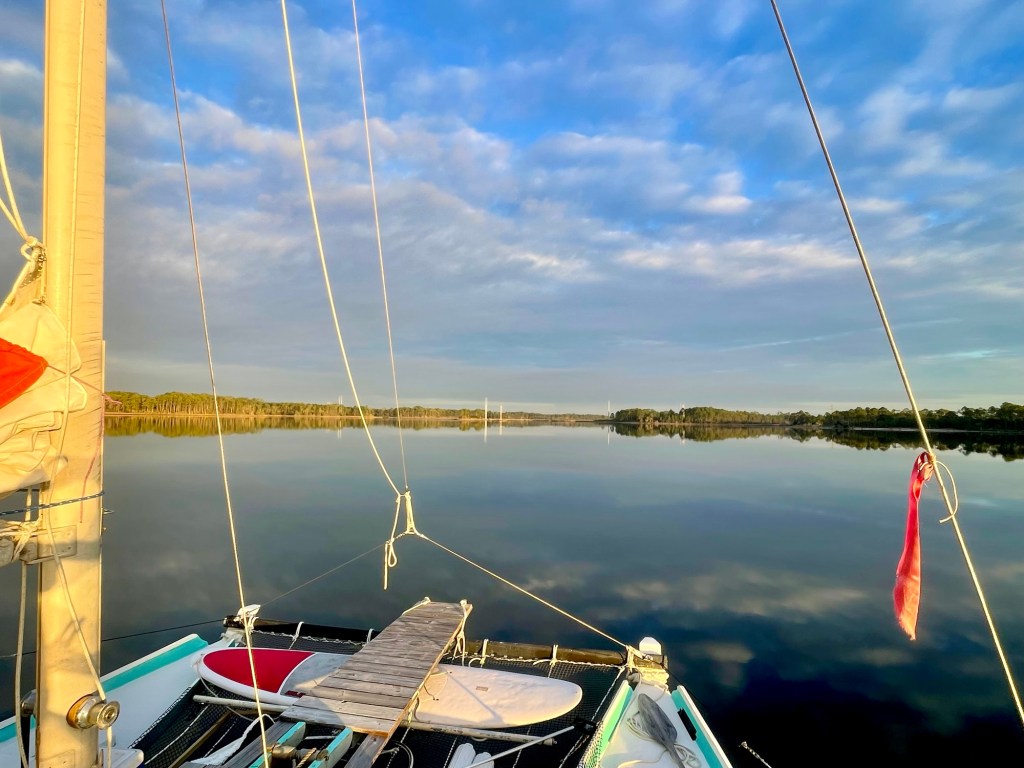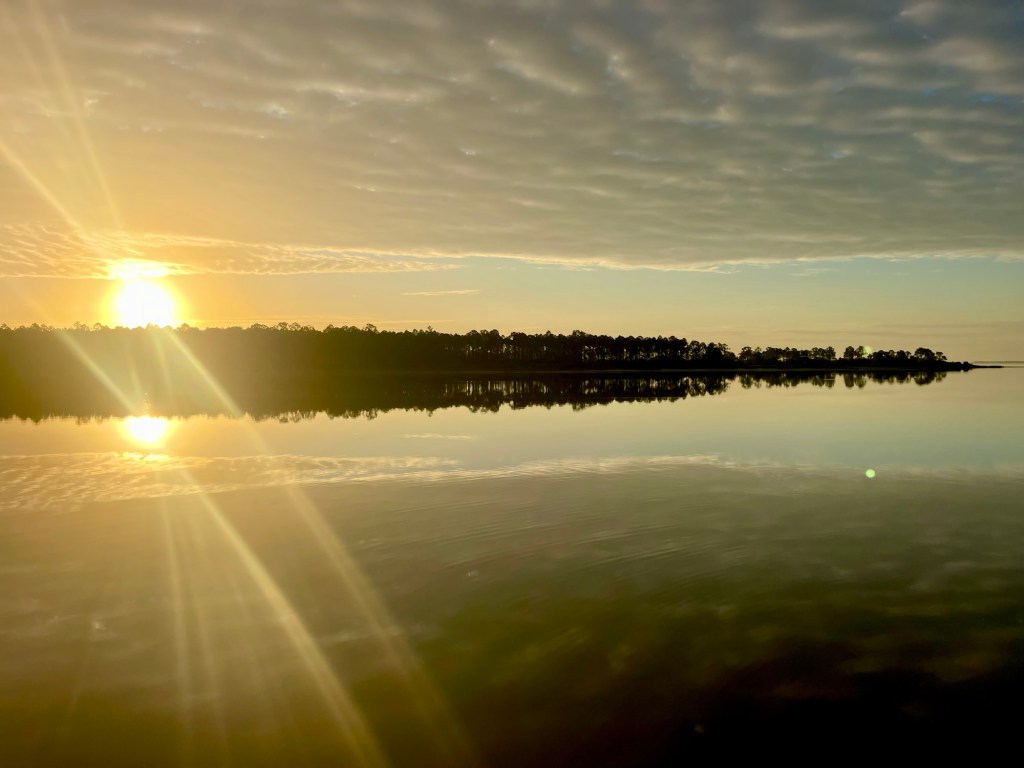
Posts Tagged With: Wharram catamaran

After Two Years of Life Aboard

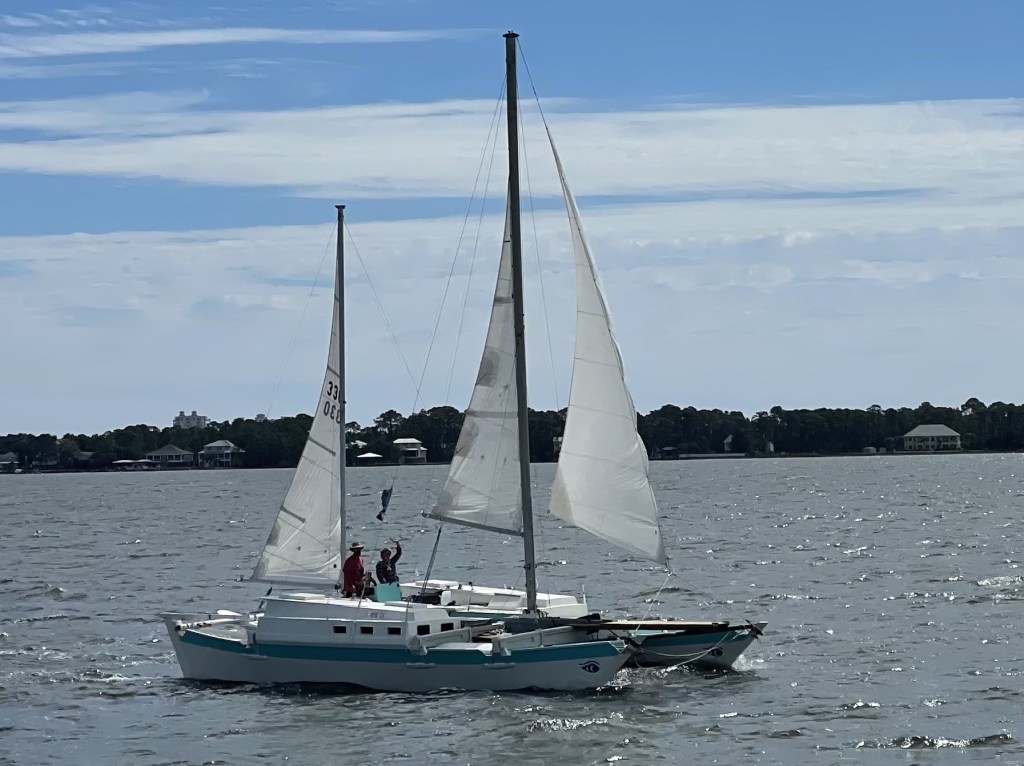
After around two years of living aboard my James Wharram Design – Tangaroa 35, I’ve come to a couple of realizations.

A Fun Lifestyle ~ For Warm Climates

Not revelations exactly—nothing dramatic or lightning-bolt in nature—just the slow, inevitable kind that sneak up on you when you’ve spent enough time with a thing that also happens to be your house. Kind of like when you’ve been sitting around the fire drinking with a mate for a few hours…then get up to take a leak and find yourself with a little stagger. It’s comes as bit of a surprise.

The first realization is fairly obvious: I genuinely love this design concept. I love the simplicity of these boats, their honesty. I’ve spent many years of my life teaching sea kayaking, canoeing, and general outdoor education. During this time I either lived out of my off-road van, or out of a backpack, or dry bags and canoeing drums. I always dreamed that the next logical step was to live on a Wharram catamaran, which in a true sense, is like living in two really, really big canoes.

These early, classic designs feel less like consumer products and more like tools. They’re basic in the truest sense of the word—unpretentious, functional, and, especially the early designs, they’re built like tanks. There’s nothing fragile about them, nothing fussy. They feel like boats that expect to be used, not living in a marina, but be parked next to empty beaches.

In Its Proper Environment

The second realization took longer to articulate, but it’s probably the more important one. These boats are extremely lifestyle-specific.

Now, what I mean by that is this: in most modern catamaran designs, a 35-foot boat is reasonably big. You can live on it comfortably. You get a proper salon, a protected center deck, a table you can gather around with five or six people, and a space that functions as a real interior room. You can enclose your world when the weather turns cold, wet, or miserable for days at a time—and when you live on board, that matters.

The Wharram designs in the 30–35 foot range, like all of James Wharram’s boats, are fundamentally different animals. They are not built to live inside. They are built to live upstairs, on deck, enjoying being a part of the environment.

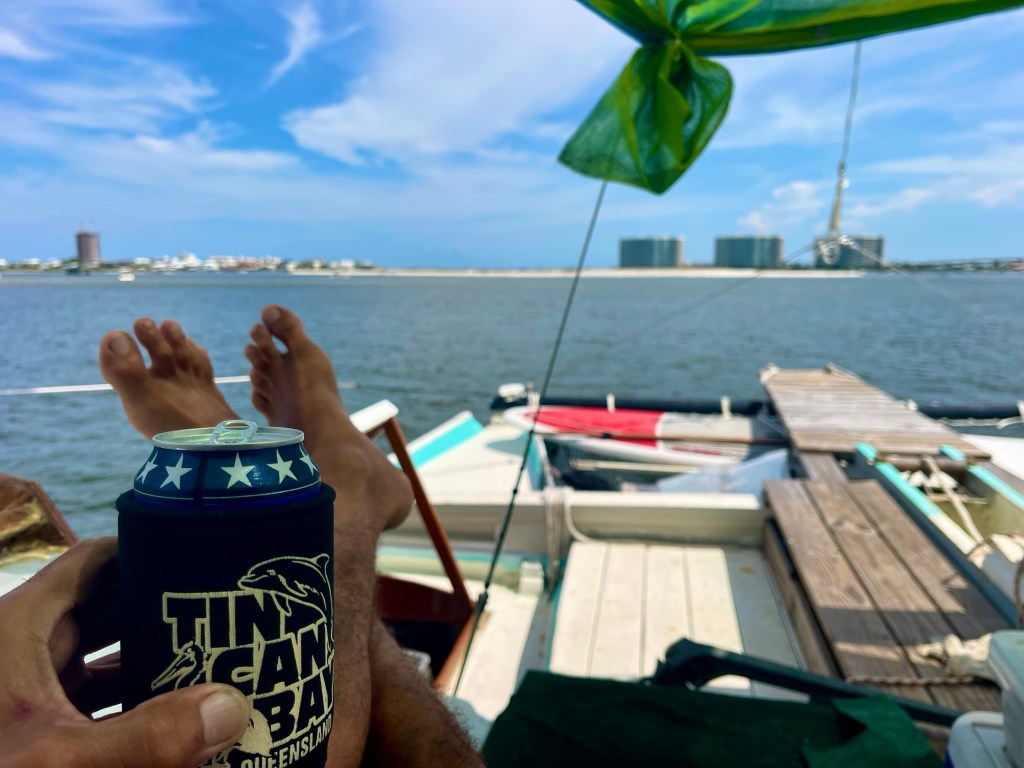
Shade From the Hot Sun, and a Cold Beer

They’re elemental boats. Outdoor boats. Boats that assume you’ll be on deck, in the wind, in the sun, in the salt, in the rain squalls, in the weather itself. Their natural habitat is warm climates, trade winds, and tropical rain showers. They utilize temporary tarps for rain protection, sun shade, and still allow airflow—not sealed cabins and climate-controlled interiors. The lifestyle they imply is more beach than marina, more barefoot than boat shoes, more tarps and canvas than fiberglass furniture.

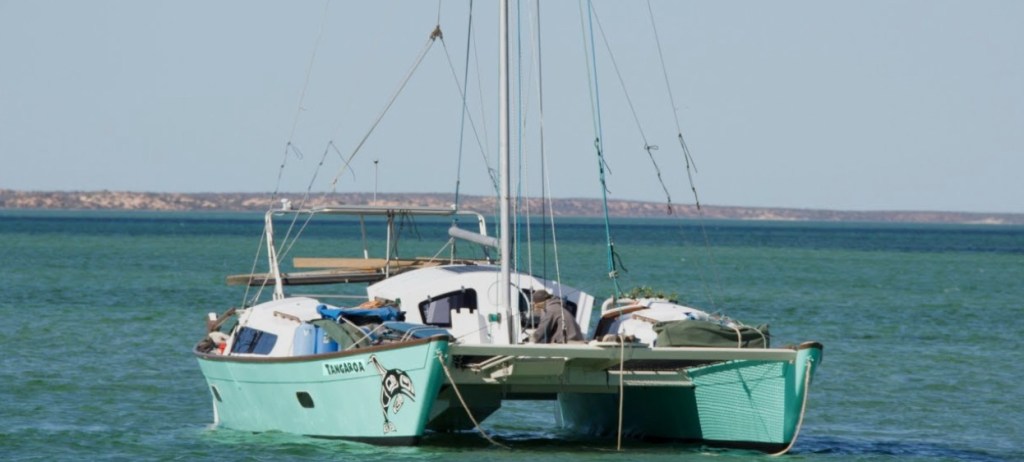
Some of these smaller Wharram owners have fitted deck pods midship between the hulls, and by all accounts, many of them are very happy with the results. A well-designed pod absolutely changes the livability of these boats.

Aqua Tangaroa with a Good Looking Pod

But this is where things get delicate.

It doesn’t take much to ruin the visual balance of a Wharram. A pod that’s a little too tall, a little too square, a little too boxy—and suddenly you’ve got what looks like a shed bolted into the middle of a boat. Proportion matters. Profile matters. Windage, matters. One of the core design principles James and Hanneke always worked to preserve was low windage profile and open decks, and it’s surprisingly easy to destroy that with good intentions and bad geometry.

Helm Station Hard Top

On my own boat, I went a more conservative route. I built a helm station hardtop that covers roughly a 6’ x 8’ area between beams three and four. From the side profile, it doesn’t really change the look of the boat much at all, but functionally it’s been a gift. It gives constant shade in summer, which, with high summer humidity and heat here on the gulf coast, is not a luxury—it’s survival equipment. And I can attach canvas and clear panels around the edges for a little wind and rain protection when needed.

Not a Complete Enclosure

What it does not provide, however, is true enclosure.

When it’s genuinely cold here from Arctic fronts that roll south through winter—when temperatures hover not far above freezing for days on end—it doesn’t create a space you can live in. It helps. It improves conditions. But it doesn’t give you a warm room. It doesn’t give you a communal refuge. It doesn’t create that psychological sense of “inside” when the world outside is unpleasant.

And that brings me to the real point of all this.

If I were starting again from scratch, knowing what I know now, I would almost certainly be living on a Wharram design in the 40 to 55 foot range.

In fact, I find myself actively daydreaming about it—about finding another rebuild project in that size class and starting over again.

Every boat I’ve visited in that size range share the same revelation: that extra length changes everything. It’s not incremental—it’s transformational. That additional length creates a massive increase in usable internal volume down in the hulls. Storage, living space, systems space, breathing room. And more importantly, it allows for a genuinely livable midship pod between the hulls that still maintains a low profile, clean lines, and sensibly low enough windage.

You can create a protected communal space without turning the boat into a floating apartment block.

And that space matters more to me now than it used to—especially under way. A protected area where other people can exist comfortably while sailing, not just endure the passage. A place to sit, read, talk, cook, and be human while the boat is moving through the world.

The other realization is more philosophical than practical.

I’ve come to see the 30–35 foot Wharrams as oversized beach cats.

A Really Big Beach Cat

That’s not criticism—it’s admiration.

They’re essentially Hobie cats that grew up, went offshore, and learned how to carry a kitchen, a bed, and a pantry. You get all the fun, lightness, and simplicity of a beach cat, but with the luxury of sleeping in a real bed, cooking in a wraparound galley, and storing enough gear, books, tools, and projects to keep yourself occupied indefinitely.

They are brilliant at what they are.

But what they are is a lifestyle choice.

And my lifestyle has quietly evolved.

I still love the simplicity. I still love the elemental nature of the design. I still love living with less, moving lightly, and keeping systems simple. But I’ve also come to realize the value of protected space, communal warmth, and the ability to hang out up on deck comfortably with friends when the weather is cold, nasty shite, rather than romantically inconvenient.

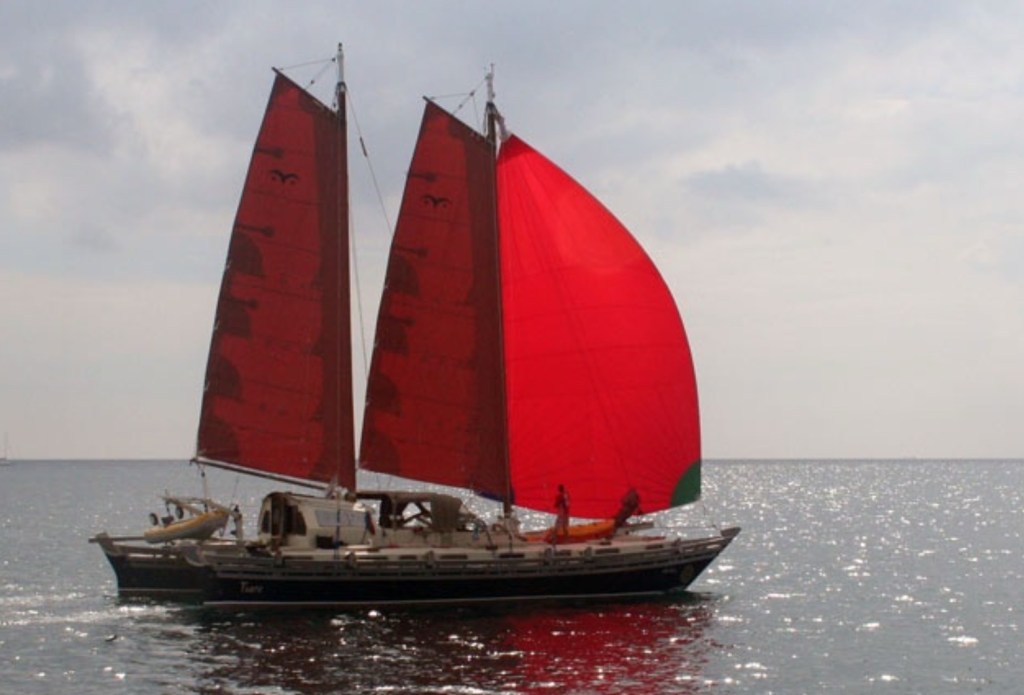
So yes—if I were starting again, I’d go bigger. Not for luxury. Not for status. Not for comfort in the conventional sense.

Islander 55 ~ Tiaré

But for livability.

For proportion.

The practicality of that extra length turns an outdoor life into a more balanced one—where you can still live in the elements, by choice, but you’re no longer owned by them.

Categories: Journey Skills | Tags: , , , , , | Leave a comment

Exploring the Gulf ICW

For the first two weeks of 2026 I’ve been gunk-holing along the Gulf Intracoastal Waterway. The weather has set the journey rhythm instead of the calendar or some imaginary deadline I’d feel obligated to obey. When conditions are good for slow comfortable cruising, I make miles—sometimes under sail, sometimes with the steady reassurance of the engine helping out. I know it’s not a purist way of sailing, but I don’t care, it’s seriously relaxing.

When the weather turns foul or even just vaguely disagreeable, I just tuck myself into some quiet, comfortable corner and wait it out. No drama, no heroics. Just patience, a good anchorage, and a sip of rum. It’s a very relaxing way of moving through the world, kind of like strolling instead of marching.

That said, if you’re the sort who stares at the chart, does the math, and thinks to themselves, “My God, I’ve only gone that far!?”—this style of cruising may drive you a little mad. Progress, in the conventional sense, is glacial. Some days the log shows no change at all, and entire weeks can vanish as if you’ve forgotten to make an entry, but it’s just time invested in simply existing.

For me, though, it’s right up my alley. I’ve never been particularly impressed by distance for its own sake. I’ve got friends in the sea kayaking world that love spending entire days paddling in open water, far from land. My place of passion was just outside the surf break, where the world gets dynamic, where life interacts and your a part of it. I’d rather know one place well than rush past ten of them just to say I did it.

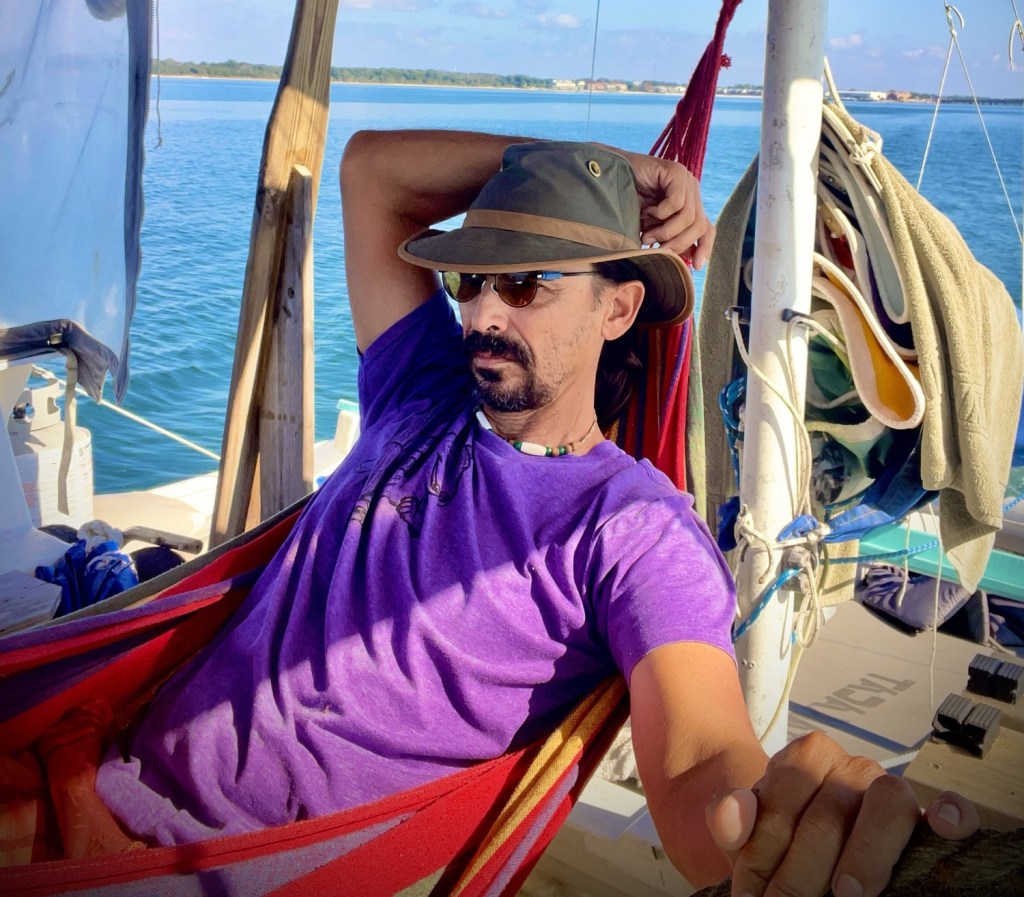
Yep, I can hang in my Hammock while steering

On the first of January I struck out for the vast horizon with all the ceremonial gravitas such a moment deserves… and went twelve miles. There I stayed there for four or five days. It was wonderful. There were only a couple of neighbors, the kind that drift in quietly, stay a night or two, and then vanish without much ado at all. I walked nearly that same twelve miles distance, this time on foot, wandering along the local island beaches. I watched fish cruise the shallows, birds going about whatever inscrutable bird business they conduct, and the trainer jets roaring around overhead, reminding me that while I was moving at the speed of weather and tide, the rest of the world was very much not. The whole affair was delightfully laid back, the days blurring together in that pleasant way that only happens when nothing is demanding your attention.

After about a week the weather forecast lined up perfectly. Clear skies, ten to twelve knots blowing exactly where I wanted to go—one of those rare predictions that reads like a personal invitation. I thought to myself “Excellent, just what I wanted”… It was wrong.

It Started Well

It started out well enough. The breeze was building, the sails were full and drawing nicely, and for a brief window in time everything felt aligned. Then, with no warning, the wind simply gave up. It didn’t shift or misbehave; it just went away. So I started the motor and settled into a long day of motor-sailing, hoping the breeze might remember it had an appointment. It didn’t. Eventually I dropped the sails altogether and just puttered along, the engine rumbling away like it was mildly disappointed in me.

Late in the day enough breeze wandered back to justify hoisting the mainsail again, more as moral support for the engine than anything else. It wasn’t doing much—until the last few miles leading into the anchorage at Navarre, Florida. There, as if to make amends, the wind filled in just right and suddenly we were making about seven knots under the mainsail alone, gliding in as though the entire day had been carefully choreographed rather than haphazardly improvised.

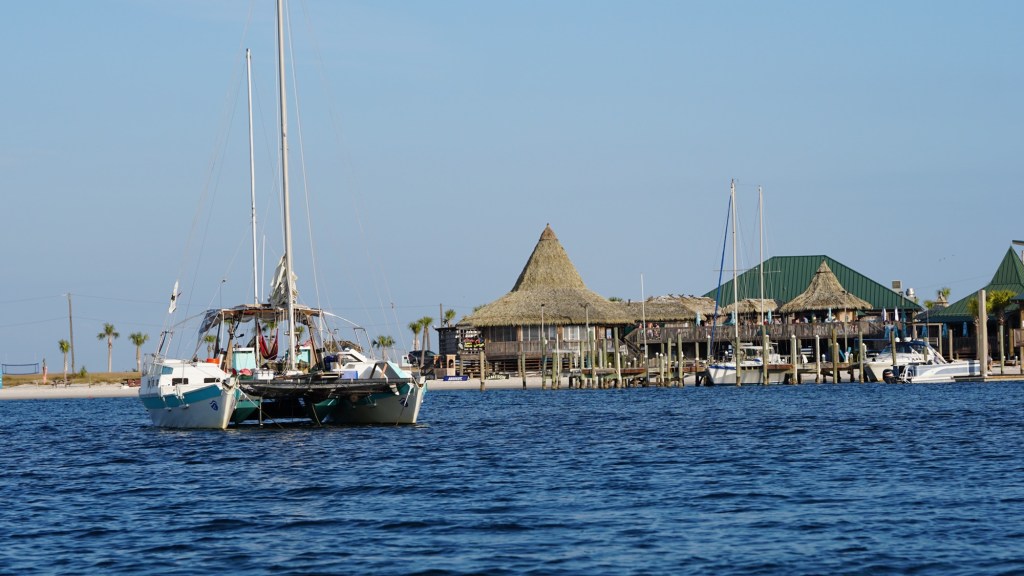
I dropped the anchor just off Juana’s Tiki Bar at Navarre, jumped into the dink, and went ashore for a cold beer. Perspective has a way of returning once there’s condensation on the glass. All in all, it wasn’t a terrible day—just a little frustrating, the nautical equivalent of being promised a smooth road trip and ending up in construction zones all afternoon.

Juana’s Tiki Bar

I’d planned to hang there for a day or two, but the weather turned overcast and a bit dreary. Add in nighttime bridge traffic and the glow of condo lights bouncing around the fog, and the place lost its charm for me. Pretty in its own way—but not the kind of pretty I’m after. I prefer my nights darker and quieter, even if fog does make the condos look like ghost ships suspended in the mist.

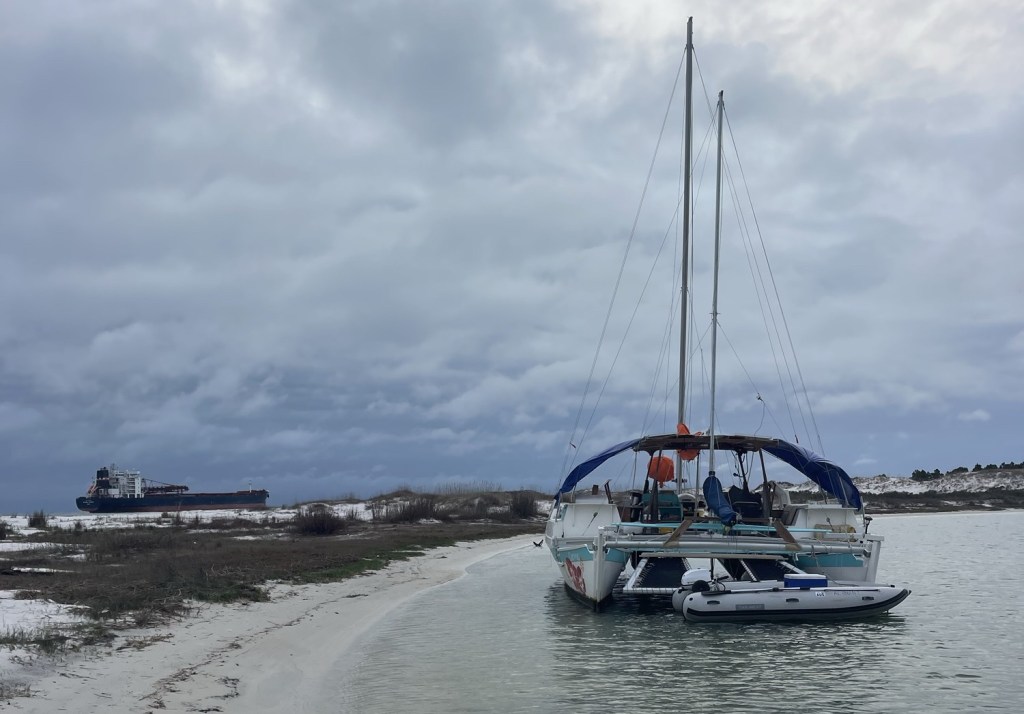
The next stop was Spectre Island, tucked into a skinny stretch of the ICW near Mary Esther, Florida. It’s a little jewel of a spot, with a delightful anchorage tucked in behind it—fully protected from weather and boat wakes, the kind of place that immediately makes you breathe easier once the hook is down.

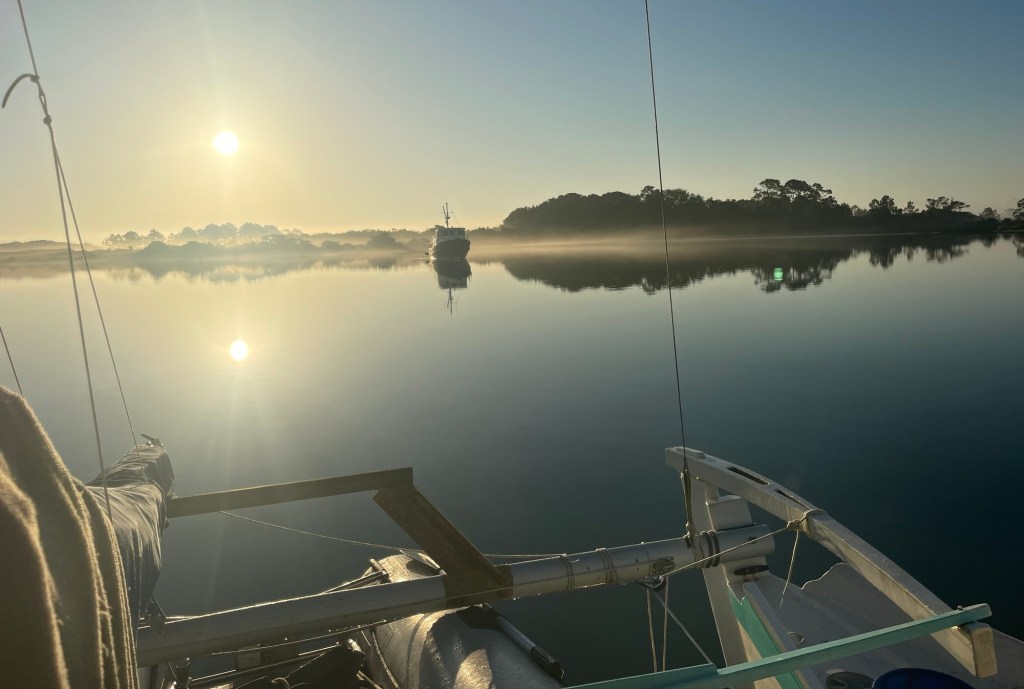
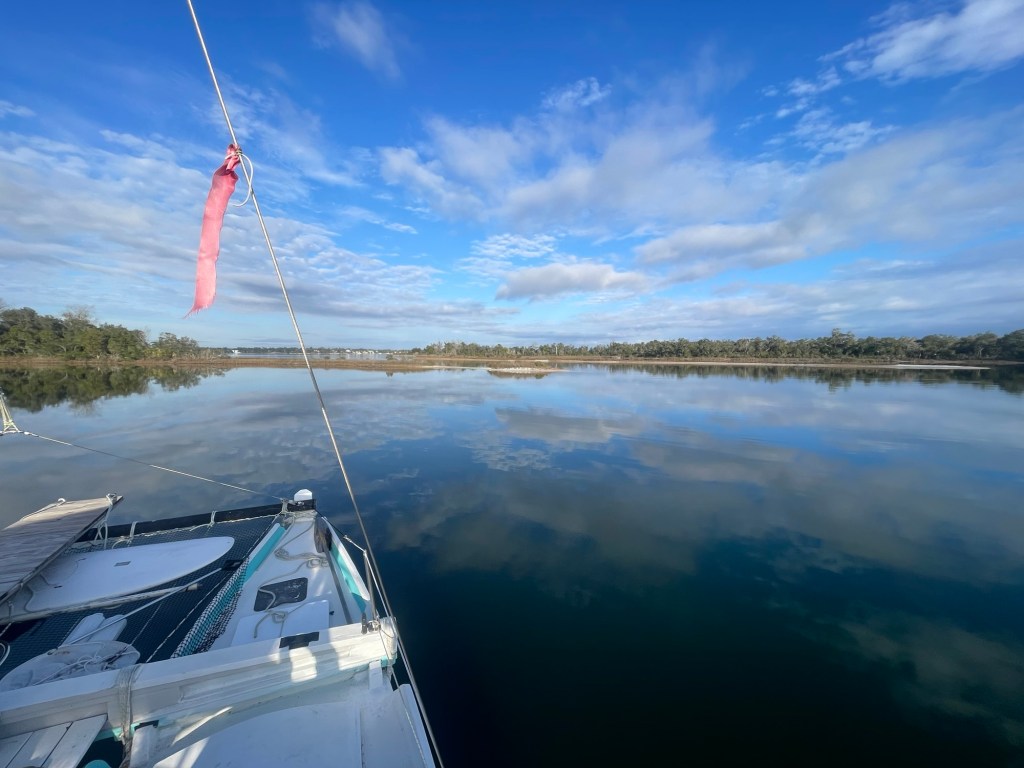
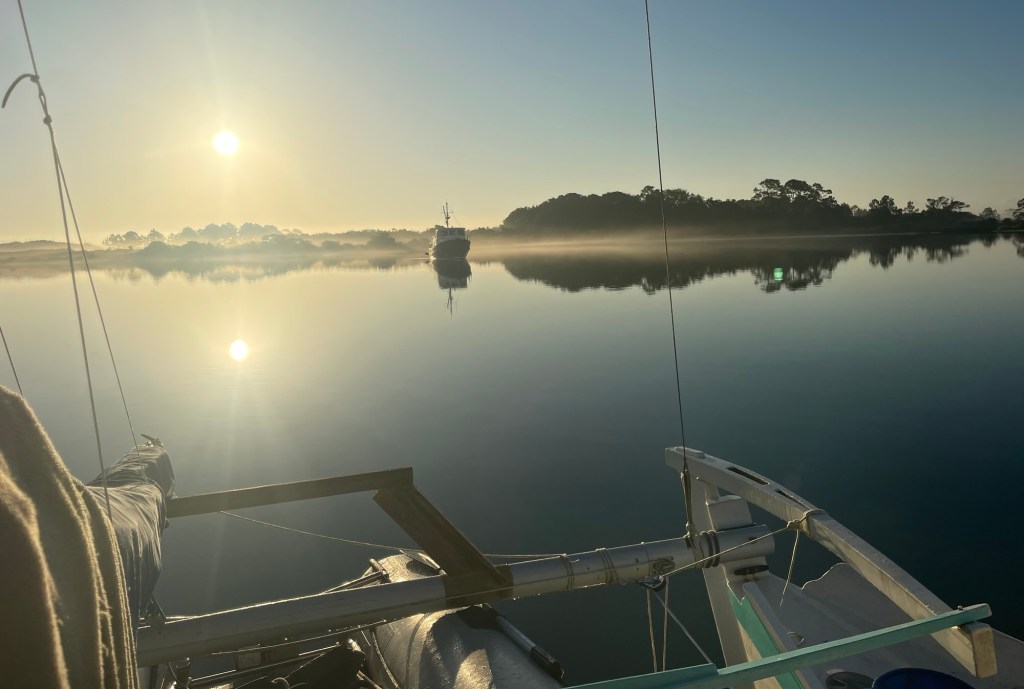
While I was there, the fog rolled in and it stayed for days, all day. Visibility dropped below a hundred feet at times, and it’s remarkable how claustrophobic it feels to sit inside a cloud. Sound and light shrink down to almost nothing, and without any real reference points the world feels oddly unreal. It’s like being stuck in a dream you can’t quite wake up from, where everything is muffled and close and slightly wrong.

Barely Two Boat Lengths

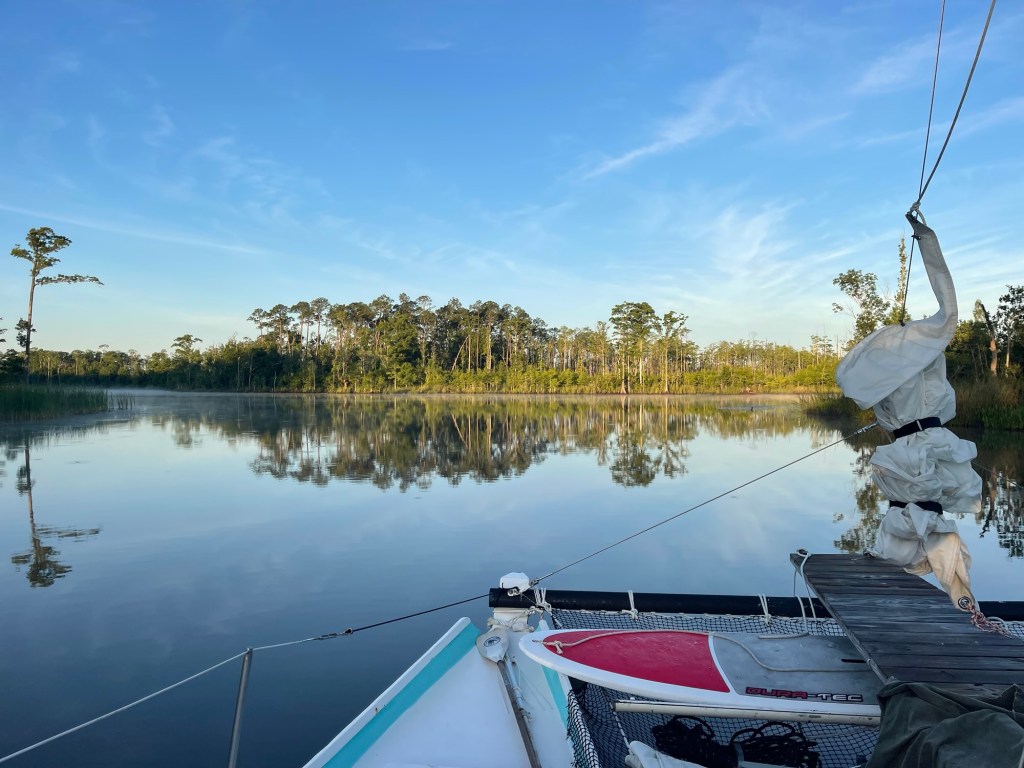
Then, eventually, the fog lifts. The sky opens up and reveals blue again, and it looks impossibly bright, as if someone turned the saturation knob all the way up. The contrast is startling and wonderful, a reminder of just how much you’d been missing without realizing it. Moments like that feel like a small reward for moving slowly enough to be there when they happen.

Not a Bad Way to Start the Day

I’ve still got a couple of days with wind gusts approaching 30 knots so I’ll remain here at anchor, watch the stingrays and herons, enjoy the surf sounds coming from the Gulf, and drink coffee and sip rum. After the front passes I’ll spend nearly a week getting to the clear emerald waters around Panama City Beach area, and do the same thing for a while.

Someone’s got to do it.

Categories: Journey Skills | Tags: , , , , , , | Leave a comment

Dinghy Cruising West Florida

Slowly sailing east from Pirates Cove, Alabama, with the intention of bumping into places interesting.

Pirates Cove~Alabama

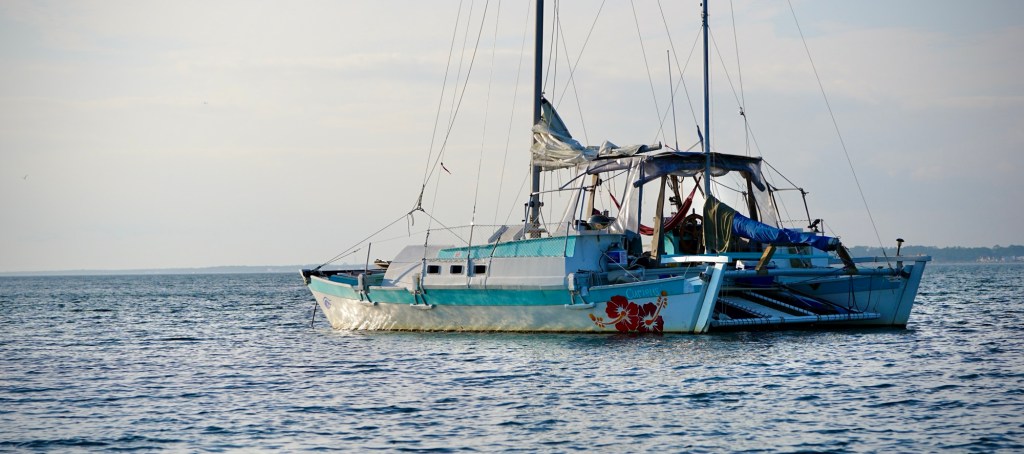
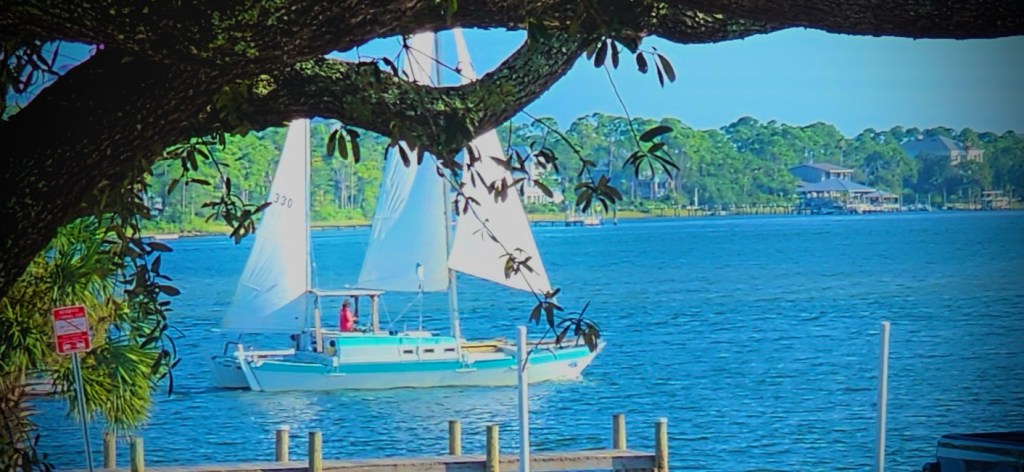
At around thirty-five feet long, the Wharram Tangaroa is certainly not a dinghy, but she does share some dinghy like qualities. For example, with a draft of only two and half feet, if we run aground I can jump in the water and push us off. And, to be honest, there has been a couple times where the depth of water and choice of direction have been at odds.

All sails can be easily raised and lowered by one person, as can the anchor with the help of a winch to pull it from sucky mud. The ketch rig balances well, and helps tremendously when tacking through light wind.

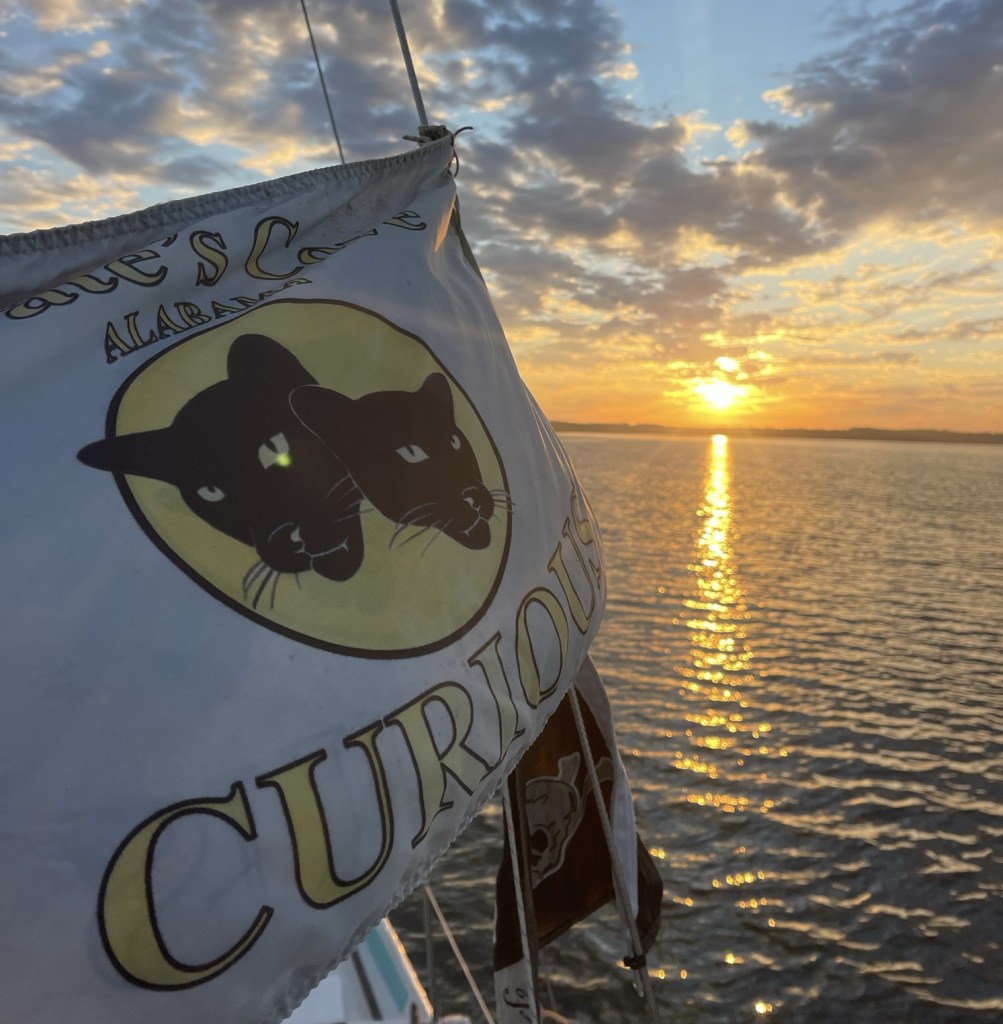
‘Curious’ is not a boat that encourages speed or a rushed schedule. She has enough volume in the hulls to accommodate long distance cruising, but overall is small enough to gunk-hole along the coast like a sailing dinghy.

Small-ish ~ Simple

We are not coastal cruisers in the traditional sense. We are dinghy cruisers who happen to be able to sleep aboard in a full sized bed and cook in a wrap around galley. My schedule is defined by which beach we’d like to stop at, our navigation is done in shade, and our overall distance ambition is an ever changing concept.

Lots of Lonely Coastline

The western coast of Florida—beginning roughly around Perdido Bay and stretching east then south in broad, slow waters—is a place uniquely suited to shallow draft boats and slow days. It is not dramatic coastline. There are no majestic cliffs throwing themselves into the sea with crashing waves, no lighthouses with heroic backstories, no fat ocean swells coming from the Gulf of Mexico. Instead there is water that behaves itself, land that doesn’t ask for much, and an endless series of places where a shallow-draft catamaran can slip in, drop the hook, and immediately forget what day it is.

Which for me happens fairly often.

Heading out on a small adventure

This western end of the Florida panhandle and coastal Alabama is a civilized place to provision, repair, delay departure, and find reasons not to leave. The shoulder seasons of Fall and Spring are unbelievably comfortable weather wise. The weather forecasts however, are largely theoretical.

The Gulf Coast, at least in this stretch, operates on a system of how much, and from which direction the wind blows. The winds control the water depth more than tides, the tides arrive whenever they please, and squalls behave like drunks in a bar. They turn up, make a mess, then disappear. This makes it ideal for people like me, who prefer sailing plans that can be altered mid-sentence.

When we finally leave Pirates Cove, our Tangaroa slides along with the soft competence of a boat that has done this before and doesn’t feel the need to comment on it. The water shifts from forest greens to coastal blues with something resembling tea with too much milk in various places. The shoreline gets a little more remote. The buildings retreat. Trees and beaches take over.

Progress becomes optional.

The Gospel of the Dinghy

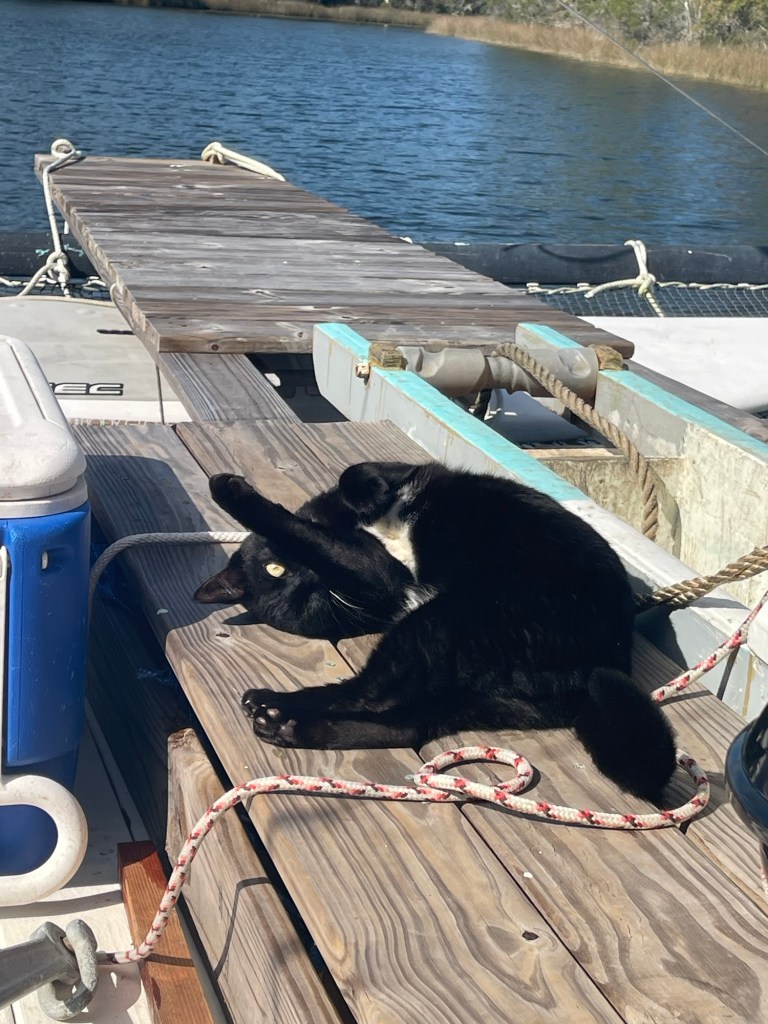
On a boat like this, the dinghy is not just an accessory. It is the primary means of resupply and exploring the really shallow places. The big boat is for sleeping, cooking, fixing things, and arguing with my cat about anchor scope. The dinghy is for jaunting about.

A Little Cat for the Big Cat

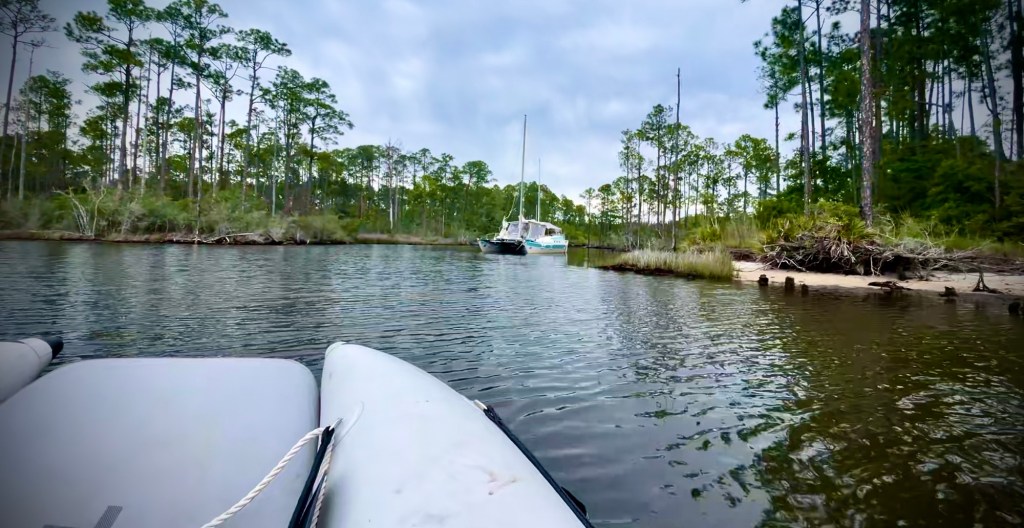
Florida’s west coast is riddled with shallow bays, creeks, passes, and unnamed bits of water that appear to exist solely to reward curiosity. The Tangaroa can nose into many of them, and the dinghy can go everywhere else. These little bays are shallow enough that stingrays ripple the surface when they scurry away and sea grass covered mud flats are home to Blue Crabs, Speckled Trout, and Manatees when deep enough. Skinny creeks that are narrow enough to make you question your choices but not enough to make you turn around. Even when a 6-8 foot alligator launches from the bank 20 feet from the dink.

This is where the Wharram design shines—not because it is fast (it can be), or stable (it is), but because it frees you from the tyranny of marinas. You anchor somewhere quiet, lower the dinghy, and the coastline opens up like a long conversation you don’t have to finish.

Some days the dinghy trip ashore is a purposeful affair—water jugs, groceries, a cold beer at a bar. Other days it is entirely recreational. You row simply because the water looks pleasantly rowable.

Anchoring as an Art Form

Anchoring along this coast is less about technique and more about manners. You choose places where your presence feels appropriate. Places that won’t mind you staying a while, away from the crowds and condo’s.

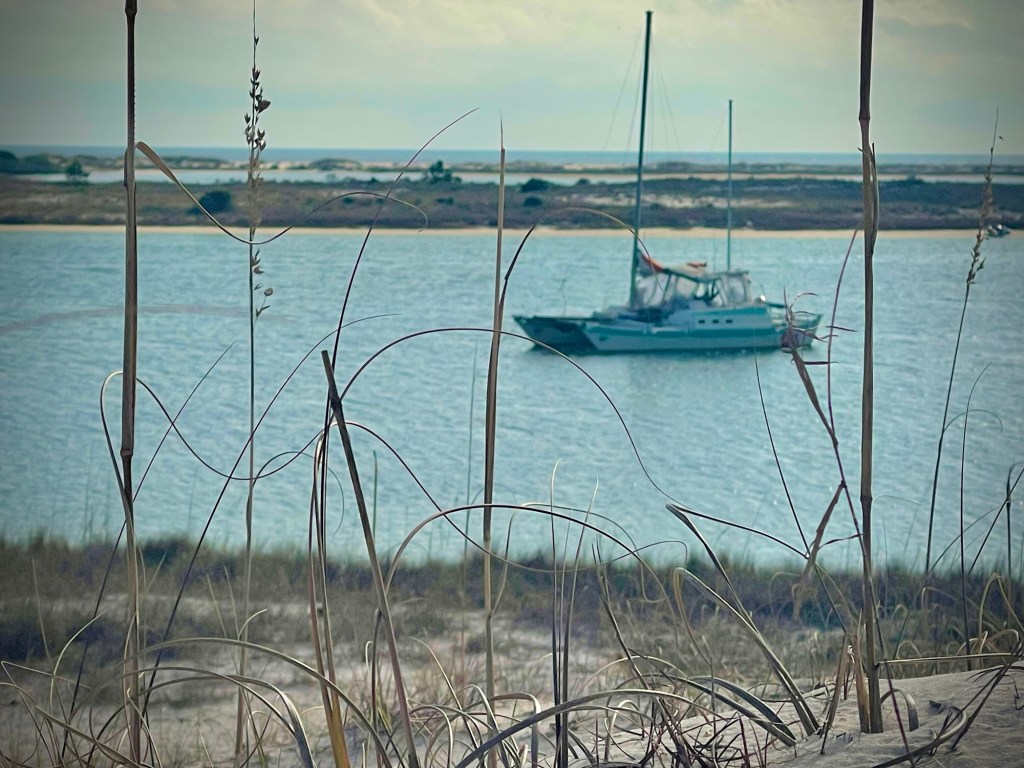
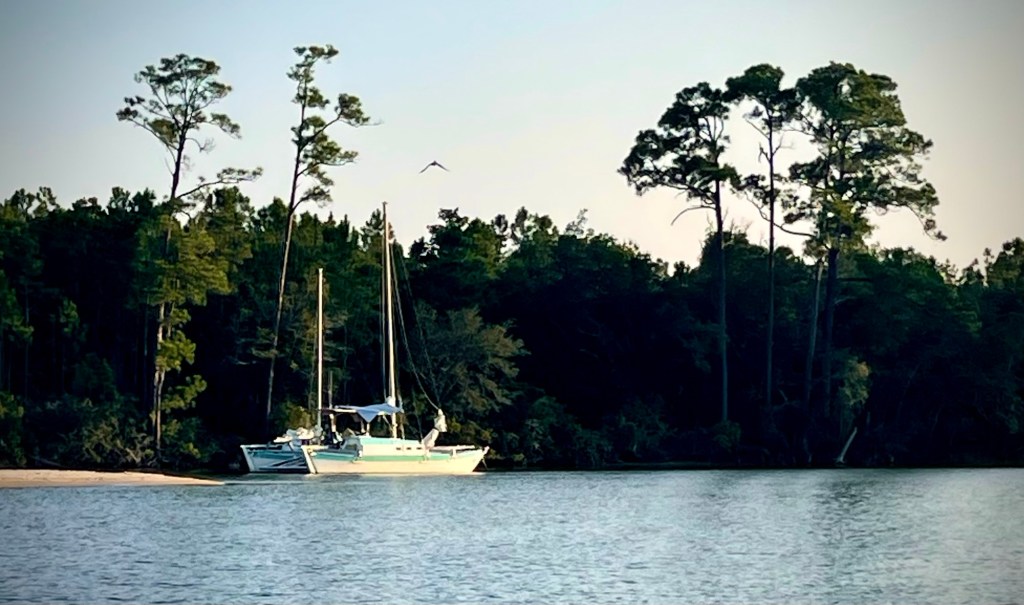
Delightfully Alone

There are broad bays where you can swing all day without bothering anyone. Narrow creeks where the trees lean in close enough to overhear your thoughts. Sand-bottom coves where the anchor sets with a quiet confidence that makes you trust it more than you probably should.

The Tangaroa, with her twin hulls and shallow draft, settles into these places without fuss. She does not roll. She does not complain. She allows you to forget that boats are supposed to move.

At anchor, time stretches. Breakfast becomes a relaxing process. Reading becomes an activity that takes up way too much time. Maintenance tasks expand to fill whatever space the day provides.

And then there is the dinghy again—waiting patiently, like a dog who knows you’ll eventually want to go somewhere.

Shore Life, Lightly Touched

The west coast towns are not destinations so much as interruptions. Small places with boat ramps, bait shops, post offices, and restaurants that serve food you didn’t know you missed until you smelled it from the dinghy.

Apalachicola

You come ashore salty, and slightly out of step with land-based time. People are kind. They’re curious, but not intrusive. They ask where you came from, then where you’re going, which is the correct question.

There is a particular pleasure in tying up the dinghy somewhere unofficial—no signs, no docks, just a bit of sand that looks as though it has been used before and will be used again. You walk into town knowing you’ll be leaving the same way you arrived: quietly.

Weather, Briefly Considered

Weather along this stretch is a background character. It exists, it has opinions, but it rarely insists on being the center of attention, unless it’s towering up and dark. Morning calms, afternoon breezes, the occasional rain squall that announces itself politely before passing through.

You learn to read the horizon rather than the forecast. You notice how the air feels. How the birds behave. How the boat feels as it dances with the wavelets at anchor.

Certainly Agreeable

Sailing days are chosen not because they are perfect but because they seem agreeable. The Tangaroa responds to this approach with steady, forgiving performance. She will sail in very little wind and tolerate quite a bit more than you’d planned for.

When conditions turn unfriendly, there is almost always somewhere nearby to hide. A bay, a hook behind an island whose name you never learn.

The Pleasure of Not Getting There

Progress southward is incremental. Measured in familiar anchorages and new ones that feel familiar immediately. You may travel ten or twenty miles in a day. Or none at all.

This is dinghy-style cruising: the big boat is transportation between playgrounds. The coast reveals itself in pieces small enough to appreciate. You learn the texture of different waters. The smell of different shorelines. The way the light changes in the late afternoon when the sun slides down into the gulf instead of cliffs.

Feels Kinda Magical

You stop caring where you are on the chart and start caring how the sun feels on deck.

Why This Coast Works

Florida’s western coast doesn’t call for heroics. It rewards attentiveness. It favors shallow draft, patience, and a willingness to spend an afternoon going nowhere in particular.

A Wharram Tangaroa fits this environment not because it was designed for Florida specifically, but because it was designed for people who value access over speed and simplicity over convenience. It’s a boat that forgives indecision and encourages lingering.

Cruising here feels less like travel and more like temporary residency. You are not passing through so much as borrowing space.

Evening

At the end of the day, the dinghy comes back aboard or is tied off astern, depending on mood and mosquitoes. The anchor holds. The light fades. The sounds shift from boats to birds to something you assume is a fish but could be anything.

Best Restaurant

You cook something simple. You eat it slowly. Sip a little rum for captains hour. Then sit and watch the water change color until it decides to stop.

Tomorrow you might sail. Or you might not. Either way, the coast will still be there, doing what it does best: offering just enough to make staying worthwhile.

Categories: Journey Skills | Tags: , , , , , , | Leave a comment

Website Powered by WordPress.com.