
Posts Tagged With: journeyislandstyle

Making a Sailboat feel like Home

Comfort while living on a sailboat? It isn’t always about systems and hardware and equipment.
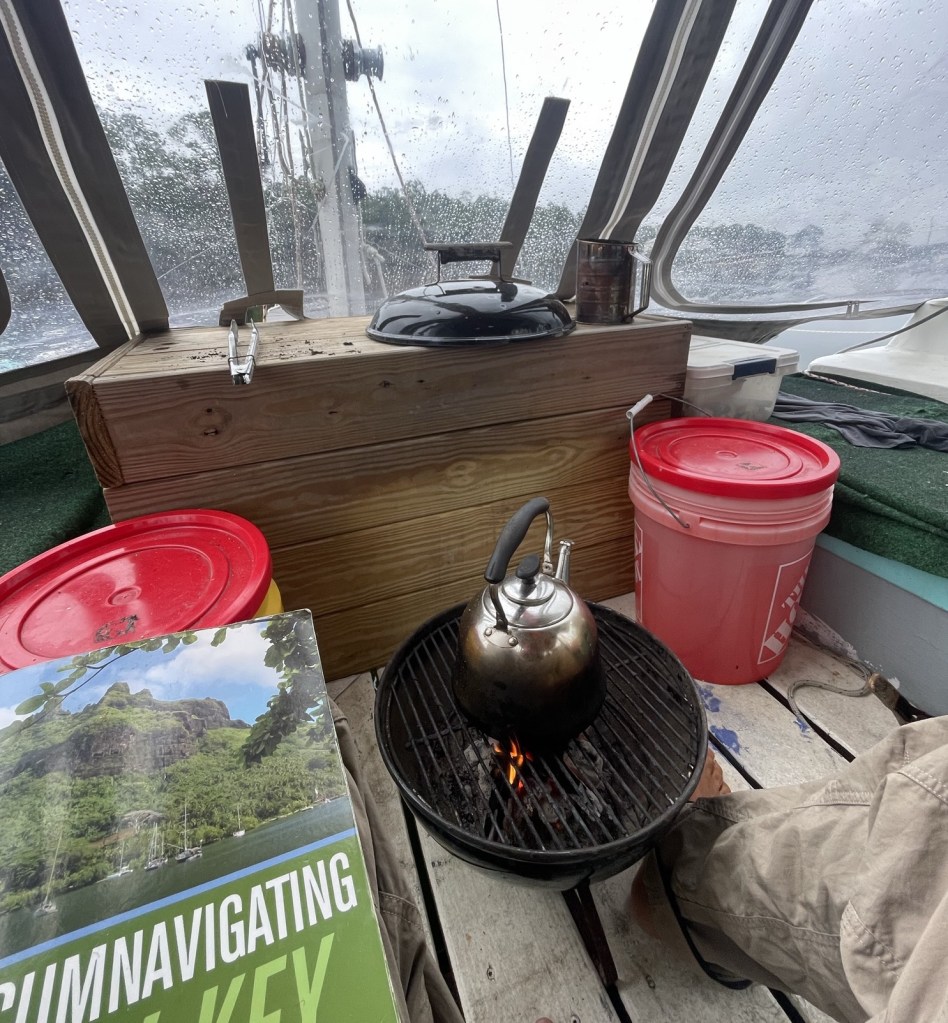
Cold, Wet Weather, A Warm Fire

For me, it is equally about ambience; music, a favorite drink, and maybe a fire in the Barbecue pit. These things add as much comfort, and a feeling of “home,” as all the other essential components.

That’s not to say a properly functioning nav system or a reliable engine don’t add peace of mind, but peace of mind isn’t exactly the same as comfort. Peace of mind is the absence of dread. Comfort, on the other hand, is the presence of delight.

The world of cruising is filled with people designing their way out of discomfort. They install water-makers and diesel heaters, inverters the size of microwaves, and enough LED lights to illuminate a football field. But the truth is, you can have every gadget a chandlery ever sold and still feel like you’re camping in a fiberglass container.

That’s where ambience comes in.

Can I Climb In Too?

It’s the quiet things that make life aboard feel less like survival and more like living. For me, it’s the gentle swing in the hammock. The lingering aroma of a Weber BBQ grill still carrying the remnants of steak and onions,…and a cold beer.

The Myth of Equipment-Based Happiness

Ask any long term cruiser what they’re working on this week, and you’ll get a detailed answer involving pumps, tanks, or electrical wiring, and the occasional curse. They’ll speak of “projects” in the same tone that farmers use for “rain.”

Rarely does anyone ever say, “I’m trying to improve the mood.”

And I think that’s a shame, because the mood is what makes the boat feel like home. Comfort isn’t just about temperature or dryness; it’s about atmosphere. You can be cold, wet, and happy if the moment feels right. Think of sitting by a campfire with a blanket, or sharing a beer on a cold beach. The conditions may not be great, but the feeling is.

The Feeling Is Good

On the flip side, you can have all the modern conveniences—a diesel heater, running hot water—and still feel lonely, sterile, and vaguely uncomfortable. Although to be honest, as much as I love the spartan, camping style of life, I do get pangs of envy when visiting a friend’s boat with its huge covered living area.

Music, Memory, and the Sound of the Sea

Aboard a sailboat, music takes on a kind of sacred importance. It’s one of the few things that can transport you beyond the sound of halyards and the creak of anchor lines.

Some evenings, I’ll play old jazz or classical guitar, something that blends with the wind in the rigging. Other times it’ll be 80’s classics and I’ll get bowled over by nostalgia, followed by the realization of how old I’ve become.

The Ritual of the Favorite Drink

If sunsets are about ambience and music is about mood, then a favorite drink is about ritual. It doesn’t have to be fancy. I’ve an old sea kayaking mate who raved about his morning instant coffee and powdered milk. I don’t think he’s right in the head.

My favorite ritual involves a thermal mug and something brown—coffee in the morning, rum in the evening, and sometimes they’ll be in the same cup, I think it’s called a Marlin Spike. If there’s nothing of importance to be done for the day, I love the flavor mixture of a rich dark coffee with a splash of Rum with breakfast. It tastes kind of smokey and soft.

Each morning around the time of sunrise, I’ll get up, measure in my coffee grounds, boil the water, and load up my half liter French press. Stir the mixture, then push the plunger down on a slight angle so the lid doesn’t contact the layer of crema. Hold the lid off the coffee and shake the press as I pour to allow the crema to flow in and cover the cups contents. I know it’s wanky, but it’s something I’ve always done, whether back packing, canoeing, or sailing.

Morning Coffee

There’s something grounding about that small ceremony. It reminds me that while the sea, the mountains, or society may be indifferent, I don’t have to be.

That first sundowner at anchor is always the best. It’s the transition point from doing to being—from being an active sailor back to a lazy human again.

The Wood-stove: Civilization in a Box

If you’ve never had a wood stove on a boat, you might think it’s overkill. If you have, you know it’s the difference between tolerating winter and enjoying it.

As yet I’ve not had one, but I have camped in cowboy style wall tents, small slab log cabins, and lean-to’s heated via a small wood stove. To say I loved that ambiance would be an understatement.

A stove does more than heat a cabin; it creates a sense of welcoming civility. Firelight softens hard edges, the smell of burning wood helps you forget about cold, wet, uncomfortable conditions outside. Even the act of cutting and storing a wood supply feels noble—like you’ve managed to domesticate the world itself, one stick at a time.

One afternoon, anchored in a quiet cove, I had the little Weber going on deck and food cooking on the grate, doing the slow, patient work that only time can finish. The tarp strung over the deck had the rain whispering against it with cold intent—not loud enough to interrupt thought, just enough to be felt. The air was thick with the mingled aromas of woodsmoke and lamb chops, that particular perfume of a camp shelter that announces you are dry, warm, and in no immediate hurry to be anywhere else. It really is one of my all time favorite situations to be in.

Perfect Feast

For a while, time stood still. My boat, Curious, was an isolated paradise. My cat had surrendered to the illusion, stretched out near the soft radiating heat of the barbecue, paws tucked, whiskers barely moving. There was no motion worth noting, no tide demanding attention, no clock insisting on relevance. There was no real schedule other than breathing.

I could have been anywhere—a cabin tucked away in the pines, a mountain hut waiting out a storm, or a small town cottage with nowhere to go and nothing expected. It was one of those small, unannounced moments when the difference between land and sea dissolves, and you realize that comfort, like home, is less about geography than it is about warmth, shelter, and a warming fire quietly doing its thing.

That’s the magic of ambience: it tricks the mind into comfort.

The Philosophy of Enough

Living on a boat teaches you to redefine comfort. For me it’s not about luxury; it’s about sufficiency. You start to realize that “enough” is a moving target—and that chasing more can lead to frustration.

I often dream of a bigger boat; B.B.S. The ability to have a center cabin between the hulls is a big attraction. I’m sitting here in the big open saloon of my friends Lagoon 40, writing away as the chilly rain is pelting down outside. I’m protected from the cold and wet. We’re at a dock with the A/C keeping the temperature just right. This kind of luxury does feel good, I admit, and I’m aware of it in the same way you notice weather you don’t expect to last.
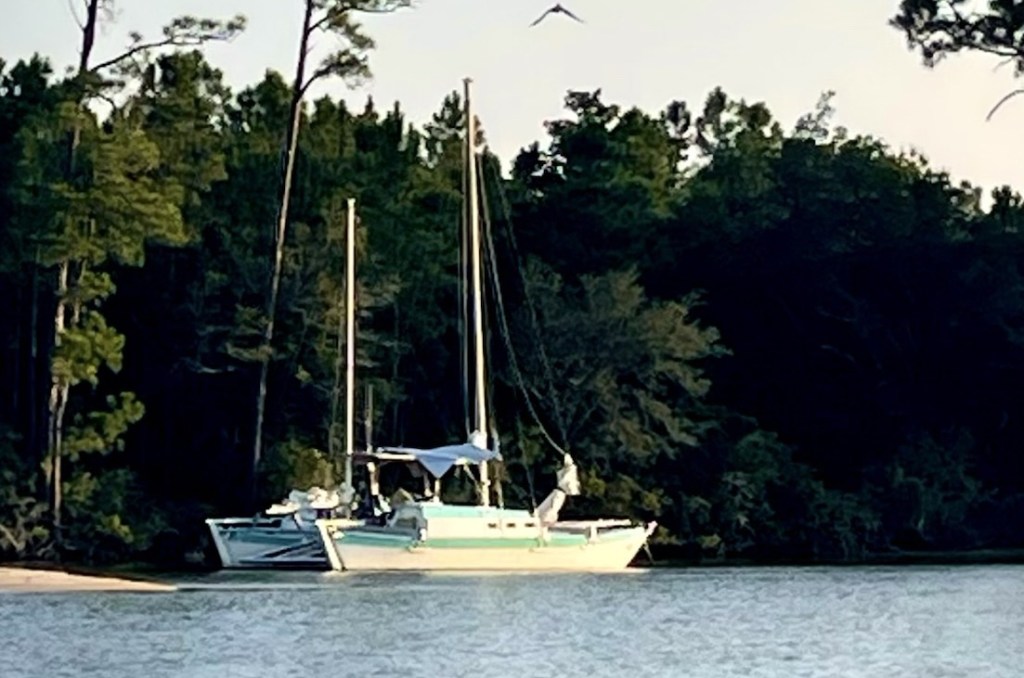
James Wharram 35 foot Tangaroa

My 35 foot Wharram Tangaroa is a wonderful boat, but building a center cabin could start to look a little clunky if not carefully kept to quite a low profile.

Perhaps I could get something bigger like the Wharram Tehini, she’s 51 feet long, very wide with loads of room, and they look oh so very beautiful. I’ll just have to keep dreaming on.

James Wharram 51 foot Tehini

Though a bigger boat generally means bigger expenses, maybe I can find some sort of trade off. Meanwhile, I’m sipping rum beside the fire on Curious, perfectly content with my limited square footage and my flickering fire pit.

Comfort, I’ve learned, isn’t proportional to space or gear—it’s proportional to appreciation.

Weatherproofing the Mind

Being constantly on the water has a way of testing your mood. There are days when the wind howls, the rain comes sideways, and every place onboard feels vaguely damp. On those days, ambience feels more like survival strategy.

You learn to create small islands of comfort in a sea of chaos. Watching a movie curled up under fluffy blankets, a hot cup of something, and a bit of light. Even humor becomes a kind of shelter.

Fluffy Blankets ~ Happy Cat

As John Gierach once wrote, “The solution to any problem is to go fishing, and the worse the problem, the longer the trip.” Substitute “fishing” with “dropping the anchor and pouring a drink,” and you’ve got the sailor’s equivalent.

Comfort Is a Choice

In the end, comfort on a Wharram sailboat isn’t a product of what you have—it’s a product of how you live. Anyone can buy gadgets; not everyone can cultivate atmosphere.

You can fill a boat with the best technology available and still be miserable. Or you can fill it with small rituals and simple pleasures and feel rich beyond measure.

It comes down to seeing the boat not merely as, ‘a thing’, but as a home.

Because when the anchor sets and the wind quiets, and you’re sitting there with fog drifting over the water ~ music humming, drink in hand, fire glowing ~ you realize that comfort afloat is less about escaping discomfort, and more about embracing contentment.

Reasonably Content

It’s not about perfection. It’s about presence.

And that’s something no amount of equipment can buy.

Categories: Journey Skills | Tags: , , , , , , | Leave a comment

The Art of Just Living

There’s an odd thing about life that nobody ever tells you straight. You’re taught how to make a living, but not how to actually live.

At school we’re driven to learn about fractions, state capitals, and the proper spelling of “Mississippi,” but not one teacher will ever sit you down and say, “Listen,—life is mostly about learning to sit with yourself without wanting to throw a chair through the window.” Which is, when you think about it, a much more practical lesson.

Simple

We are so preoccupied with achievement, acquisition, and arranging our calendars into neat little blocks of self-importance that we forget there is an art form more subtle than piano, more challenging than oil painting, and more elusive than tightrope walking: the art of just living. Not living well in the way glossy magazines mean—perfect kitchens, toned arms, weekend yoga retreats—but simply living. Being here. Existing without apology, without fanfare, without the endless business of improvement.

It’s a skill that takes decades to master, and even then, you’ll slip. Sometimes you’ll catch yourself trying to turn your morning coffee into a productivity hack (“Bulletproof coffee, guaranteed to make you twice as unbearable at meetings!”). Other times, you’ll fall for the siren call of self-optimization, as if downloading another meditation app will help you breathe better than the lungs you were born with. And yet, every now and then, you stumble into a quiet moment of unpolished living—watching the cat stretch in the sun, stirring sugar into tea, or standing barefoot on a patch of cool grass—and you realize: Ahh, this is it. This is the thing.

It Just Feels Good

Chapter One: The Trouble with Living

The trouble with living is that most of us treat it like a career path. You’re meant to “make something of yourself,” which is an alarming phrase if you pause to think about it. What, exactly, are you right now—nothing? A lump of clay? A misplaced sock? The idea of “make something of yourself” suggests that existing, just as you are, is a bit of a half-baked effort, like bread pulled from the oven too soon.

So we go about patching ourselves up with goals, titles, and possessions. Some people collect degrees, others collect children, and still others collect pairs of running shoes that may never touch a pavement. We look for evidence of a life well-lived in external trophies. Yet none of it really proves much of anything. I’ve met three-story houses who are emptier than a local swimming pool in Winter. I’ve met fishermen, with weathered hands and sunburnt noses, who are wealthier in contentment than a banker with a retirement account that could fund a small island.

Basic Simplicity

And here’s where the humor creeps in. Because if you take the human race at face value, we’re a fairly ridiculous species. We invent devices to save time and then use that saved time to invent more devices. We now install apps on our phones to track our steps and then spend hours sitting down scrolling through how many steps we haven’t taken. We rush through meals so we can rush through work so we can rush home and “relax,” only to find ourselves too wired to actually enjoy it.

If an alien anthropologist were to study us, I imagine its report would read something like:

“Our subject species spend 80 years attempting to figure out how to enjoy 80 years. Success rate: questionable.”

Chapter Two: The Gentle Rebellion of Slowing Down

If there’s any real art to just living, it begins with slowing down. And slowing down is its own kind of rebellion. It is the refusal to be hurried into existence, the audacity to say: I will not live my life as though I’m late for a train that never arrives.

Take mornings, for instance. Most people greet the day as though it’s an opponent in the boxing ring. Alarm goes off, adrenaline spikes, and suddenly you’re punching your way through showers, coffee, emails, and traffic. But mornings are not meant for fighting. They’re meant for stretching, yawning, shuffling about in slippers, and standing aimlessly in the kitchen wondering if bread counts as breakfast (it does).

When you slow down, life reveals its details. You can enjoy the warmth of the coffee mug in your hand. Taste, and appreciate, the difference between good butter and nasty, cheap butter. You realize that the neighbor’s dog barks at the mailman every morning at precisely 9:17, as though the dog has been hired by the Post Office as a form of occupational hazard. These little details are where living actually happens, always rushing can bury this awareness.

And it’s funny isn’t it, that we can pay fortunes to travel the world in search of meaning, yet miss it entirely in our own world? Consider these two scenarios.

# “I once spent an afternoon in Fiji talking to a man who owned nothing but a canoe and a couple of coconuts, and he was one of the most peaceful souls I’d ever met.”

# “I once spent an afternoon in a boardroom listening to executives argue over font size on a PowerPoint slide.”

Which of these afternoons was closer to living than the other.

Chapter Three: The Cult of Busyness

Of course, slowing down isn’t fashionable. If you admit to not being busy, people look at you as though you’ve confessed to stealing their garden gnome. Being busy, and stressed from work is our modern badge of honor. Ask anyone how they’re doing, and most will say something to effect of, “Mate, I’ve been flat out like a lizard drinking!” It’s a humblebrag disguised as suffering.

Just Keep Pushing

We even compete over it. “You’re busy? Well, I’ve been so busy I haven’t had a proper meal since February.” “Oh, that’s nothing. I’ve been so busy I haven’t seen my children since they were babes-in-arms, and now they’re leaving home.”

What nobody wants to admit is that busyness is often just noise. A kind of frantic filler to avoid the terror of sitting quietly with oneself, risk being bored. Because in that silence, the big questions come up. Who am I? What am I doing here? Have I made good life decisions. Should I finally fix that leaking tap? And heaven forbid we face those.

The art of just living requires courage—the courage to do less, to own less, to expect less. And that can be terrifying in a world that insists that more is always better.

Chapter Four: The Joy of the Ordinary

One of the most overlooked truths about life is that the ordinary is not something to escape from; it is in fact the the marrow of existence. Yet we’ve been tricked into thinking joy lies elsewhere—in exotic vacations, promotions, or Instagram-worthy milestones. Ordinary things are treated as the background music of our lives, when I think they should be thought of as the symphony.

Consider the afternoon cup of tea. Not the fancy ceremonial kind, but the humble, chipped-mug, bag-left-in-too-long sort of tea. To me, that first sip on a quiet afternoon contains more wisdom than a hundred self-help books. It says: here you are, still alive, still capable of enjoying the small quiet moments. Or even consider the laundry—yes, laundry. Pulling warm clothes from the dryer on a cold day is one of those mundane joys that deserves a parade.

Just Enjoy The Moment

Francis Whiting, with her subtle humor, would tell you this: life is not made of grand declarations but of the tiny stitches that hold the day together. A laugh with a stranger. Enjoy the smell of garlic frying in the pan. The squeak of a floorboard you’ve stepped on a thousand times.

Each night my cat prowls over my bunk around two in the morning gently meowing, and half purring. I used to get frustrated and grumpy with him, but now it’s usually a reminder that he’s in my life looking after me, and I should get up and check the anchorage situation,…and maybe get him some treats.

When you start noticing and appreciating the ordinary, it can grow into the extraordinary. The way afternoon sunlight splashes through the trees. The way rain sounds different depending on whether it hits tin, glass, or leaves. The way kitchen aromas drift up from the galley. This is living. Not glamorous, not headline-worthy, but profoundly real.

Chapter Five: Humor as Survival

Let’s not forget the importance of humor in all this. Life, left unjoked about, can become unbearable. Commitments pile up, our body starts to creak, repairs need to be done, and when it’s all said and done, we all end up in the same place (spoiler: it’s in the ground). Without humor, the weight of life could crush us. As the saying goes, “Don’t take life too seriously, you’ll never get out alive.” With humor, even misery becomes tolerable.

Think about how often laughter sneaks into life’s bleakest corners. Hospitals, for example. The sickest wards are often filled with the loudest jokes. Or funerals, where stories of the departed bring both tears and giggles. Humor is how we remind ourselves that while life may not always be under our control, our perspective on it can be, and is good to be cheeky.

Personally, I find the universe has a wicked sense of humor. You finally save enough to buy a reliable car, and the week after, someone invents teleportation. You spend years learning how to cook, and suddenly the doctor tells you to avoid everything that tastes good. Or you carefully plan your future, and then a pigeon decides you’d make an excellent target.

The art of just living is, in part, learning to laugh at these cosmic pranks.

Chapter Six: The Unfinished Masterpiece

Here’s the thing though, no one ever fully masters the art of just living, and maybe that’s the point. If you could graduate a course of “Living 101” with a certificate, it would stop being life and become a program.

Living is messy. It’s full of days when you don’t want to get out of bed, of weeks when nothing goes right, and years that feel like a misprint. It’s also full of wonderful moments that sneak up on you—the kind that makes you laugh at the sheer audacity of being alive at all.

You’re not meant to have it figured out. You’re meant to stumble through, collecting scraps of wisdom, the way a beachcomber collects shells. Some will be broken, some complete, and some sharp enough to cut you, but all of them are proof that you were here, that you walked along the shore of existence and that you paid attention.

Take The Small Moments

Epilogue: Practicing the Art

So how do we practice the art of just living?

Notice the small things. They are part of the bigger picture.

Reject busyness. Wear your free time like a badge of honor.

Laugh often. Especially at yourself.

Be ordinary. It’s the most extraordinary thing you can be.

Don’t take it too seriously. Nobody gets out alive.

In the end, the art of just living is less about achievement and more about surrender. Less about carving life into a masterpiece and more about sitting in the sun, afternoon drinks, and realizing that the masterpiece was here all along.

So sit. Breathe. Watch the cat stretch. Laugh when the toast burns. Smile at the absurdity of it all. You’re not behind. You’re not missing out. You’re not unfinished.

You are practicing the Art of Just Living.

Categories: Journey Skills | Tags: , , , , | Leave a comment

Why I do what I do

Why I do what I do.

From the very beginning I have never really understood the world we live in.

Life Confusion

©www.aag.com

Continue reading

Categories: Uncategorized | Tags: , , , , , , , , , | 1 Comment

Website Powered by WordPress.com.