Posts Tagged With: Wharram

Cruising Life on a Wharram

Long term cruising on a Wharram catamaran along the bayous and shallow bays of Alabama and the Florida Panhandle is an education in slow water, muted weather, and a patience shaped by tides you can almost—but never quite—predict.

Just Slow Down and Enjoy

Here, sustained north or south winds matter more than the tide tables; blow long, and hard enough and they physically pile water into the bayous or drain it back out. More than once, the wind has rewritten the day’s expectations, leaving channels and mudflats much shallower than expected. At least that’s excuse I’ve used after my keels have kissed the bottom.

This is not the glamorous end of sailing, the blue-water fantasy sold in brochures and drunken stories. There are no real trade winds here, no flying fish, no tropical idyll. Instead, the water is green and opaque, the air heavy with insects, and the bayous are thick with baitfish. Which is precisely the point.
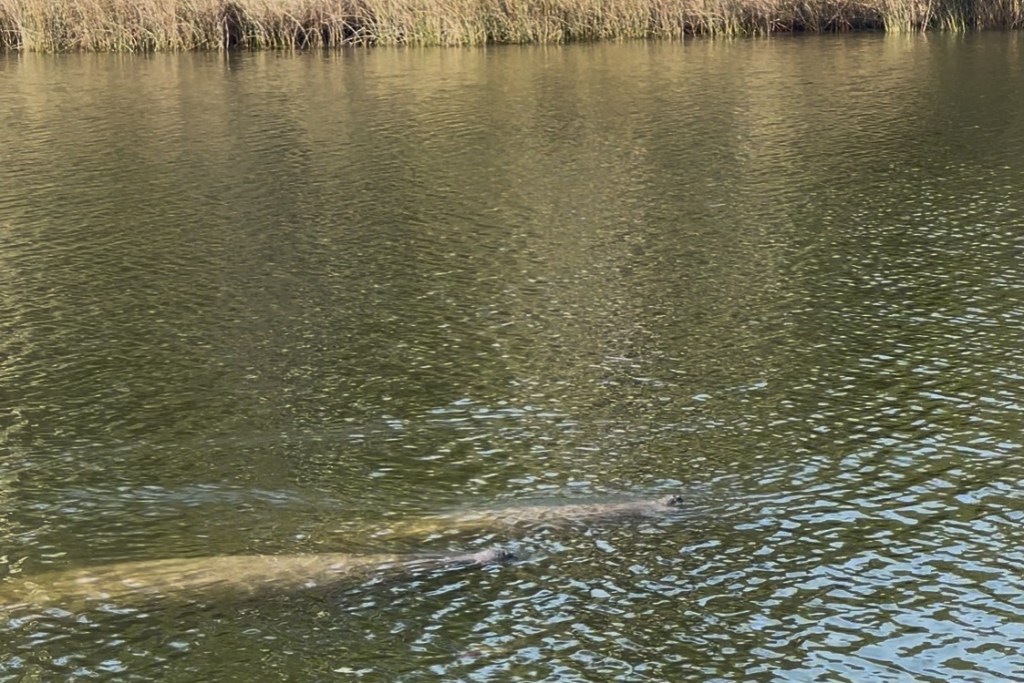
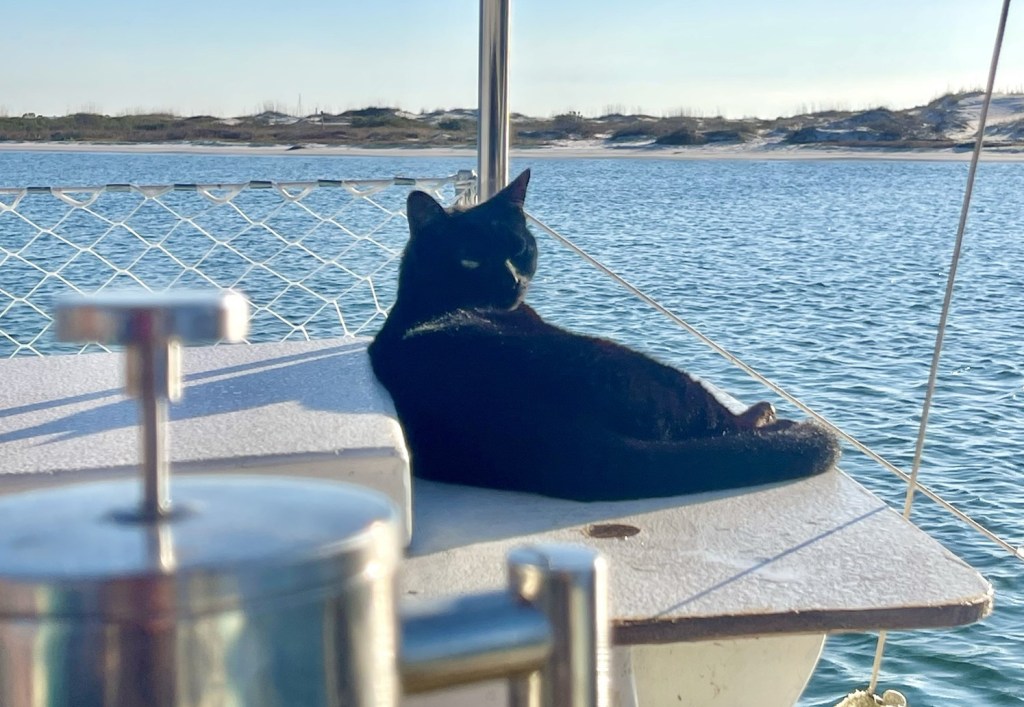
Manatees Just Hanging Out

The dolphins understand this better than anyone. They come not for the scenery but for the economics of it. Food gathers here, and where food gathers, predators follow. I’ve watched dolphins catch a fish, toss it into the air, chase it down, catch it again, and throw it once more—not out of cruelty, exactly, but because they can. It looks playful from a distance, the way all nature does,… when you’re not the one being played with.

From the boat, it’s entertaining in a quiet, passing way, something to watch while the kettle boils or the tide turns. The fish, I suspect, would describe the experience differently.

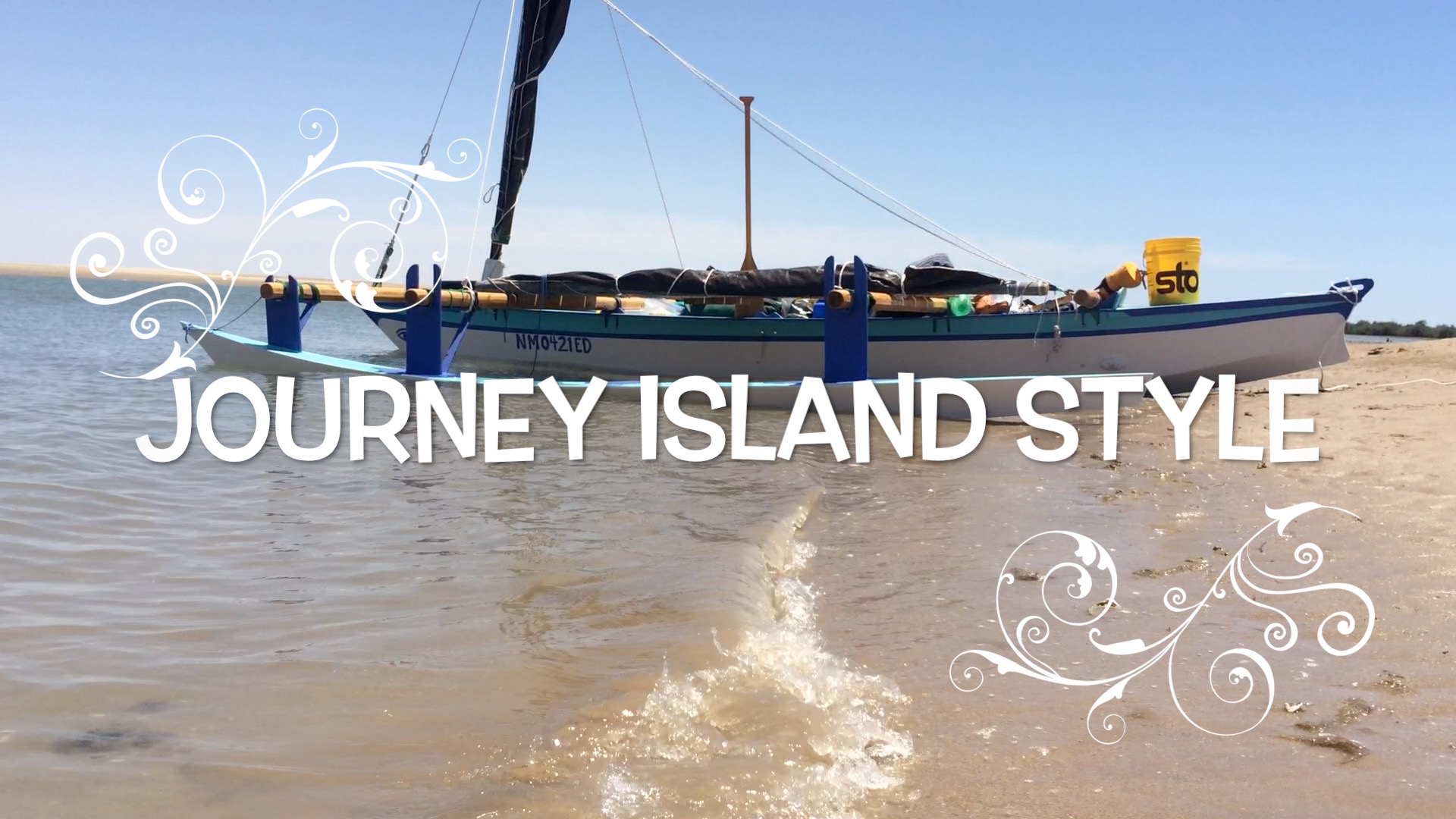
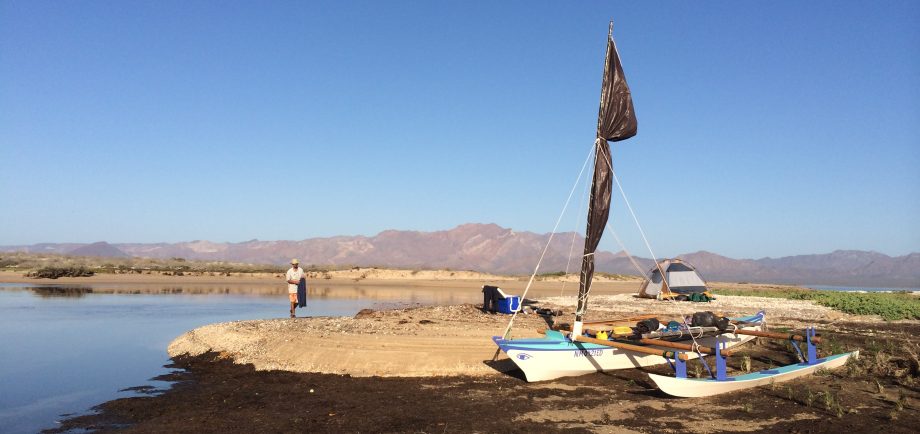
A Wharram doesn’t demand attention. That is perhaps its greatest virtue in these waters. It sits lightly on the water, almost politely, in places where deeper draft boats fear to go. With its narrow hulls and shoal draft, the boat invites exploration rather than concern. You can sneak into creeks that look too small to matter, glide over shallow sand bars, and anchor in water skinny enough to watch crabs and stingrays searching for food.
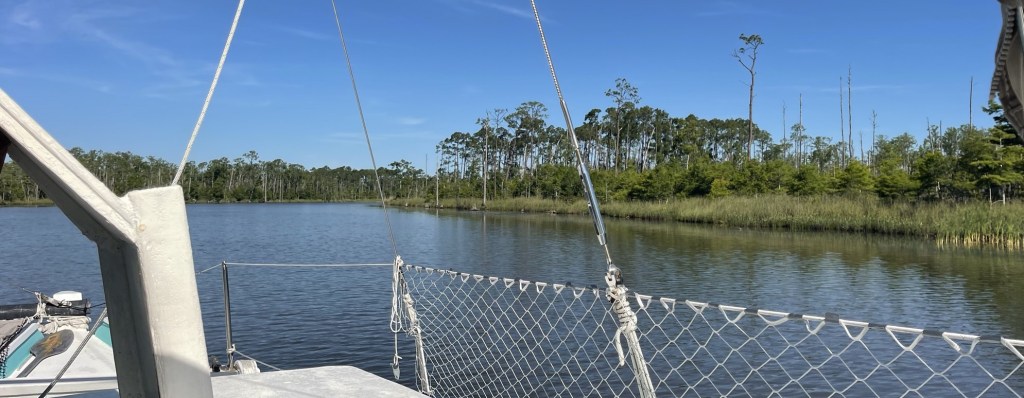
A Very Quiet Anchorage

The Alabama and Florida Panhandle coast is a quilt of environments stitched together by tides and tannin-stained water. There are open bays that feel deceptively spacious until a northerly wind kicks in and turns them into a bouncy, angry washing machine. There are parts of bayous so delightfully serpentine they wrap around you like a hidden path, and the occasional disdainful heron will squark loudly because you got too close. There are the barrier islands, low and sandy, that on one hand appear so very fragile and on the other they’ve stopped the entire ocean dead in its tracks for thousands of years. A Wharram makes sense in all of it—not because it conquers the environment, but because it cooperates with it.

In summer, life aboard starts early, mostly because the heat insists on it. In winter the sun rises sharp and clear, and by midmorning the cabin is already warm enough to encourage activity. The Wharram’s accommodations are famously simple—some would say spartan—and that simplicity becomes an asset here. There is little to manage, little that can break, and nothing that requires shore power to feel “normal.” You wake with the dawn light, make coffee on a stove that doesn’t care where you are, and sit on deck watching the water change color as the sun rises. There is no rush, because nothing in these waters moves quickly except storms, and they provide a little advance notice.

Wide Open Shallow Waters

Anchoring becomes an art form. Not the deep-water, chain-and-scope arithmetic of offshore sailing, but the careful judgement required in shallow bays with soft bottoms and shifting winds. A Wharram rides easily to anchor, rarely sheering, and draws so little that you can often anchor where deep draft monohulls wouldn’t consider stopping. This opens up opportunities invisible to most cruisers: little side bays, dead-end creeks, the backsides of barrier islands where the sound of the Gulf is just over the dunes. You learn to read the bottom by its color, to trust your eyes more than your electronics, and to recognize the subtle difference between mud that will hold and bottom that will simply shrug and let go.

Weather governs everything. Summer brings heat and thunderstorms that rise out of nothing and flatten the world for an hour or so before moving on. You learn to reef early—not because you need to, but because it makes life easier—and to set awnings and sunshades as soon as possible after the anchor drops. The Wharram’s open structure helps; breezes move through the boat instead of being trapped inside it. Nights are a study in contrasts: heavy air, chirring insects, the click, clack, and snap of shrimp sounds through the hull, and stars bright enough to make you forget about air conditioning entirely.
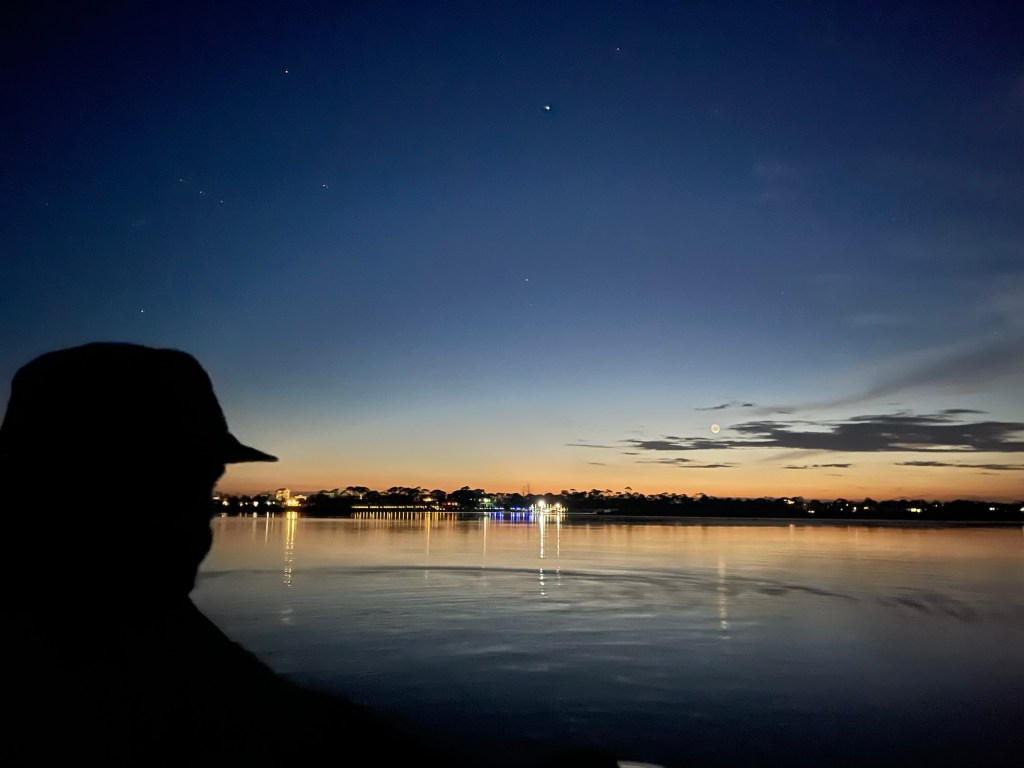
Magical Nights

Winter, by contrast, is crisp, cold and often beautiful, but less forgiving. Strong northers blow down the rivers and across the bays, pushing water out and leaving docks with surprisingly little water around them. Here again the Wharram excels. Its light draft means you are rarely left high and dry unless you choose to be. You can tuck into creeks for protection, nose into the backwaters where the wind dies completely, and wait out the blows with relative comfort. You become intimately familiar with cold mornings, condensation, and the quiet satisfaction of a hot breakfast eaten while the world outside shivers.

Provisioning is part of the rhythm. Grocery stores appear intermittently, often far from available docks. Living on a Wharram encourages modest needs: fewer things, better choices. You carry what you can realistically store and accept that fresh vegetables are a treasure rather than a guarantee. Fishing fills some of the gaps—not romantically, but practically. Speckled trout, redfish, the occasional flounder if you are lucky and patient. Meals become simple and satisfying, shaped as much by what the water offers as by what simple stores I can carry.

Simple Food Supply

The social world is small but memorable. Along these pieces of coastline, people notice a Wharram and often ask questions. It looks different, unapologetically so, and it invites conversation. Fishermen idle over to ask what it is, how it sails, where you came from. Some are skeptical, others enthusiastic, but nearly all are curious. There is a sense that anyone choosing to live this way must either know something important or be slightly unhinged. Often, it’s a combination of both. Marinas are rare, and when you do tie up, you are treated less like a transient customer and more like a temporary resident with an interesting story.

Solitude, though, is the dominant feature. Days, occasionally even weeks, pass without speaking to another person. You learn the sounds of the place: the low thunder of distant surf on the barrier islands, the hiss of wind through spartina grass, the outboard engines whining faintly miles away. There is a humility in this isolation. The land here is not dramatic in the way mountains are dramatic, but it has weight. It changes slowly and remembers everything. Living on a Wharram, you float lightly across it, an observer more than a participant, tied to nothing but tides and weather.
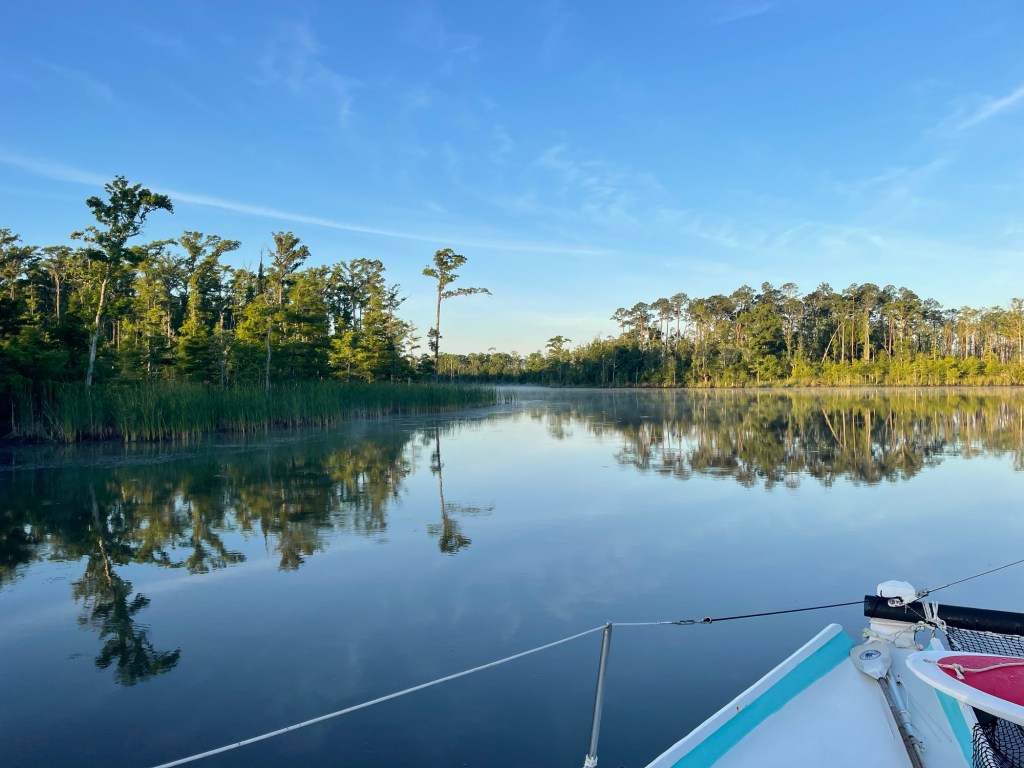
Not a Bad Place to do Maintenance

Maintenance, such as it is, fits the scale of the boat and the environment. Salt still corrodes, sun still punishes, but the systems are few and accessible. Wood, rope, and simple hardware age honestly. You sand, paint, replace, and move on. There is satisfaction in knowing every part of your home, in understanding how loads affect the way the boat moves, how water finds its way in, and how to persuade it back out again. A Wharram doesn’t demand perfection—only attention.

The shallow bays and bayous reward curiosity. You start exploring places with no names, or names that exist only on paper charts. There are afternoons spent drifting with the current, sails down, letting the boat slide quietly past marsh grass and oyster banks. Birds become neighbors: ospreys watching suspiciously from channel markers, pelicans gliding past at arm’s length, herons lifting reluctantly as you pass. These moments are small, easily overlooked, and completely absorbing. They are the currency and markers of this life.

Storm preparation is taken seriously, but not dramatically. You learn the patterns, the safe pockets of protection behind islands, the places that offer protection from surge and wind. The Wharram’s lightness is again an asset; it doesn’t fight the water so much as dance with it. Lines are secured, anchor’s checked, and you settle in to wait. When storms pass, the world feels scrubbed clean, rearranged just enough to remind you who is in charge.

Very Humbling

Living aboard in this region teaches restraint. You don’t push schedules, don’t force passages, don’t pretend the weather will cooperate because you want it to. The Wharram reinforces this mindset. It sails best when allowed to do its own thing, when trimmed gently and not pressed. In return, it rewards you with easy shallow access, and a sense of being exactly where you belong—even when that place is an unnamed bend in a bayou with mosquitoes thick enough to darken the air at sunset.

Perhaps the greatest gift is perspective. From the deck of a small, simple catamaran, the Alabama and Florida Panhandle coast reveals itself as a working landscape, not a resort brochure. Shrimp boats leave before dawn, and bridges loom overhead, all are indifferent to your passage. Shorelines change from wild marsh to modest towns without ceremony. You are close enough to see the details, far enough removed to avoid being entangled by them.
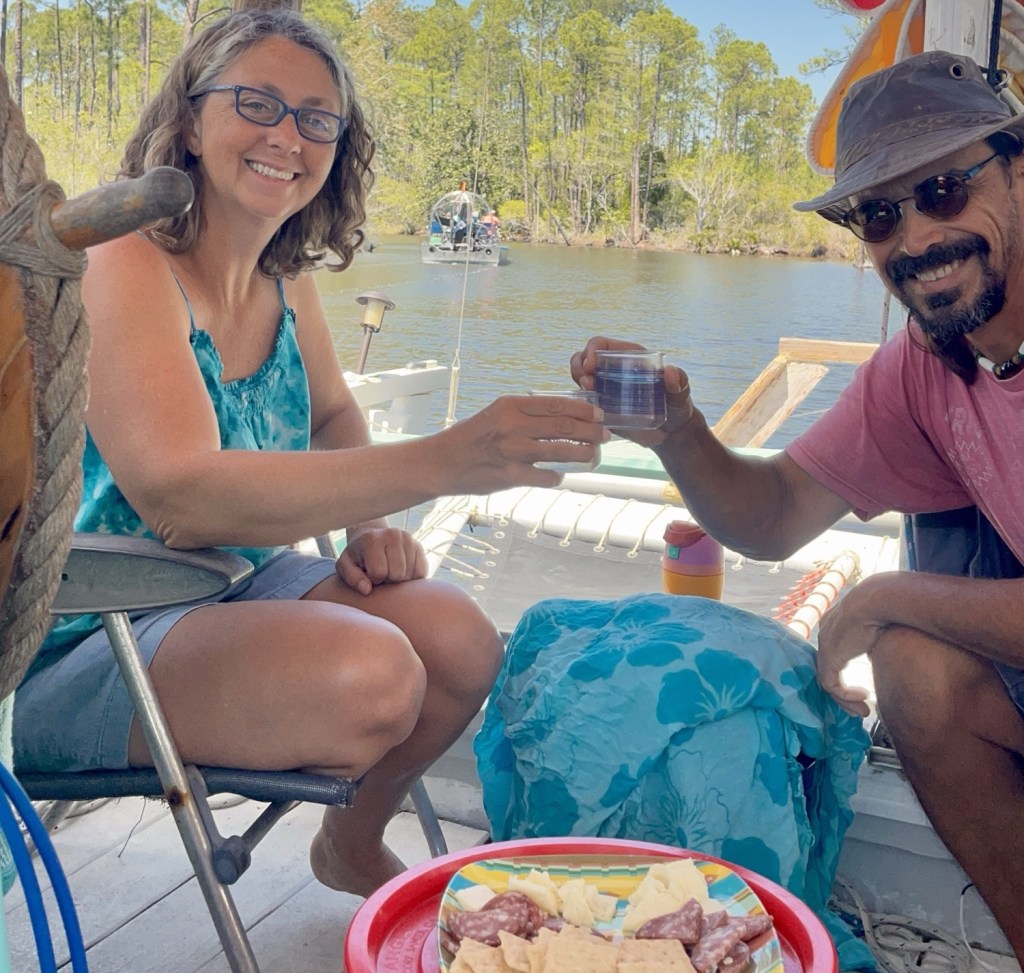
Cheers

In the end, living on a Wharram catamaran here is less about adventure and more about alignment. The boat fits the place, and the place fits the pace. It is a life stripped of excess and rich in observation, where days are measured in tides and light rather than miles covered. You move slowly, live lightly, and learn—over time—that this quiet corner of the Gulf Coast has more to offer than it first appears.
Categories: Journey Skills | Tags: , , , , , , | Leave a comment

Life Changes Just Around the Corner With the New Season (Aboard a Wharram)

There’s a specific kind of silence that drifts over a Wharram just before the cool change of season.

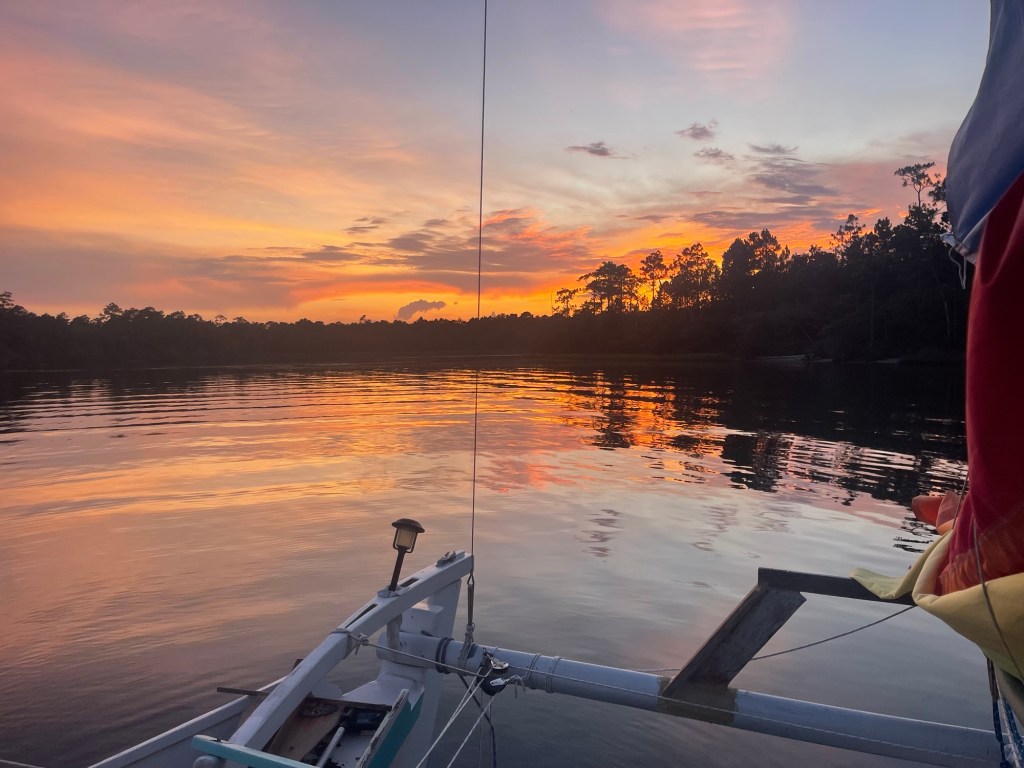
Sunsets Are More Comfortable

It’s not just the temperature of the air or water—those are easy enough to identify. I find a silence that’s… something else, something subtle. It’s a pause. A breath. A moment where the world seems to lean in, as if it’s waiting for whatever comes next.

I’ve lived aboard for nearly two years now. What’s become apparent is the recognition of change. In the same way you recognize the creaks of the hulls or the gentle rumble of the kettle coming to a boil. I feel the world shifting, and my little floating life is about to shift with it.

The thing about seasons is that they don’t just happen outside of you. They happen within you. And living on a Wharram—a boat that invites a deep kind of intimacy with weather, time, and the many moods of our aquatic world —you feel these shifts in more ways than one.

The First Signs Arrive Quietly

It’s rarely the big, dramatic signs that tell you the season is turning. The signs arrive in very subtle ways.

For example when summer is approaching its end.

Changing Temperature

One morning, you wake up and realize the deck feels cooler under your bare feet. Not cold. Not even chilly. Just… cooler. The morning sun doesn’t arrive with the intense heat of mid summer anymore. The daily arrival point of “it’s too damned hot” happens a little later each week.

It also begins to show at sunset. No longer is the last couple of daylight hours filled with the intense blowtorch heat from both the sun and its reflection from the water. You can now sit, in the shade, without sweating like a dripping sponge.

The world is changing.

So are you.

Living Close to the Vagaries of the Season

For me, living on a Wharram means living at the mercy—and delight—of the small details of the natural world. There’s no central heating . No thick insulation slowing the transfer of heat.

A Wharram is an honest boat. Admirably so.

When the season shifts, the boat tells you long before your calendar does.

The lashings seem to change their tension depending on humidity, allowing the beams to sometimes creak in their sockets when the boat gets rocked by waves. The morning air slips over the bows with a different character you can’t hide from. I’m exposed to it just from making my morning coffee, it’s in the other hull with an open deck in between.

And you become an involuntary weather-watcher.

Most people have to step outside to feel the season. You simply wake up and feel it immediately—in the boards under you, the air inside the cabin, the way your pillow holds warmth or releases it instantly.

There is nowhere to hide from seasonal change aboard a Wharram.

Delightfully Exposed

But that is precisely what makes it beautiful.

Seasonal Shifts Bring Inner Shifts

The funny thing about the changing season is that it always seems to come hand-in-hand with a quiet internal rearranging. Every new season invites a different version of you to step forward.

Maybe that version is more contemplative.

Maybe more adventurous.

Maybe a little tired and ready for rest.

Maybe itching to do a refit, finish repairs, or start those improvements you swore you’d get to when “things slowed down.” Not that they ever really sped up on a Wharram.

Many Projects

Living on a Wharram makes this inner-shift especially unavoidable. The boat’s openness invites self-awareness of a rare kind. The elements aren’t out there. They’re right here, drifting through the living space, humming in the rigging, tapping lightly at the hulls and cabin tops.

A new season arrives, and you feel you’re being nudged toward something. A different rhythm. A bolder mindset. Or simply the kind of small internal maintenance that humans need just as much as boats do.

We don’t often talk about spiritual oil changes, but maybe we should.

The Rituals of Transition

The strange thing about seasonal transitions aboard, especially leaving summer, is that they always initiate a kind of domestic dance—small rituals that prepare you, your boat, and your mind for what’s coming.

You might have:

Another blanket or two that now lives permanently on the bed

The small heater to ward off the morning chill is out of storage

The hatch above the bed doesn’t open quite as early in the morning

Put away the fans and pretend you’re not a little sad to see them go

Consider where you stashed the cold weather gear months ago

These rituals are the liveaboard’s version of migrating geese—or squirrels storing nuts, only you’re pulling sweaters or repositioning your cold foul-weather jacket so you don’t find yourself hunting for it at exactly the wrong moment.

Winter’s Coming

There’s a quiet satisfaction in these small preparations. They aren’t exactly chores; they’re acknowledgments. Telling yourself, I see what’s coming. I’m ready in my own small way, at least I think I am.

And maybe that’s what seasonal transitions are all about—becoming ready for something you can’t quite articulate yet.

The Emotional Weather Report

If I were to file a personal weather report during this seasonal change aboard, it might read:

“Growing swells of introspection, increasing probability of mild restlessness, warm pockets of nostalgia, and scattered clarity across the afternoon. Winds variable, blowing toward future possibilities.”

Seasonal anticipation for me rides its own kind of emotional tide. I’m not necessarily sad, nor necessarily excited, but suspended in that productive in-between space where reflection becomes easier and clarity tends to drift in and out unexpectedly.

This is why the changing season often brings questions I haven’t thought about in months:

Should I reorganize the cabin?

Should I write more?

Should I finally fix that one squeak that I only hear at 3 a.m.?

Am I moving in the direction I want, both literally and metaphorically?

What do I truly want out of the next few, colder, months?

Not a Terrible Office

I dream of warm tropical beach’s right alongside dreaming of the unbelievable beauty of cold northern places like Nova Scotia.

These questions drift in the same way clouds drift across the sky—sometimes fast, sometimes slow, sometimes gathering in meaningful formations. And living aboard means you have the time and space to actually notice them.

Life ashore often moves too quickly for these thoughts to gather traction. Aboard, they drift in and out naturally like the tides.

Letting Go of One Season Before Entering Another

One of the quiet truths of living on a boat is that you’re always letting go of something.

Sometimes it’s literal—objects that don’t fit the space or get used enough, clothes that don’t suit the climate, gear that you finally admit isn’t pulling its weight.

Too Many Maybe Things

But other times, it’s internal. Outdated worries. Old priorities. Habits that once made sense but don’t anymore

And I think each season asks you to release something different.

Summer asks you to let go of excess—too much clothing, too many indoor activities, the belief that you need walls to feel secure.

Autumn asks you to slow down. There’s no need for constant motion.

Winter asks you to accept the comforting monotony of early nights, warm drinks, and low-key living.

Spring demands you let go of dormancy—the temptation to stay comfortable, quiet, unchanging.

Living aboard seems to heighten all of this. There’s no spare space to hoard possessions or old versions of yourself. You become intimately aware of what your “next season self” may not be anymore.

For me this feels healthy, almost instinctive. Just as the Wharram needs to be a minimalist environment, your mind benefits from getting rid of clutter. Just as the boat can be reorganized for the seasonal change, you can reorganize internally.

You let go, because the season asks you to.

The Wharram and the Wider World

One of the unique joys of living on a Wharram is that it gives you a front-row seat to the drama of the natural world, without drowning you in theatrics.

The open decks, the simple nature of the hulls, the flex and give of the rigging—all of it creates an intimacy with the change in seasons. Nature doesn’t shout at you through glass. It whispers through the fibers of the boat itself.

And at the same time, living aboard lets you feel connected to the broader human experience.

People everywhere feel the tug of seasonal change, even if sheltered from it. Even if they ignore it as the heater kicks on or the first frost carpets across their car’s windshield.

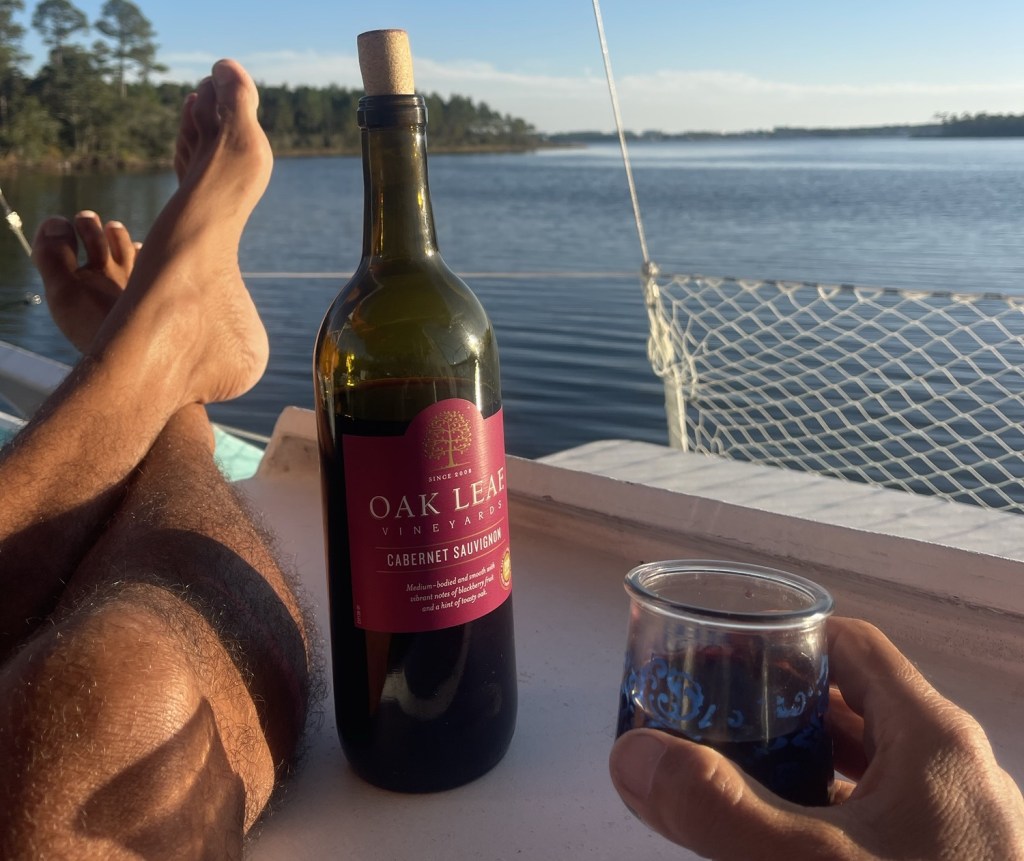
While they sit in their climate controlled cars or apartments, you sit on the exposed deck with your morning cup in your hand and the sky wide open above you.

Big Skies, Hot Coffee

In a way, the experience is universal—you’re just… closer to the source.

The world is changing for everyone. You’re simply noticing it sooner.

The Inner Compass That Turns With the Seasons

Every person has an inner compass—an instinctual direction that shifts ever so slightly as the season does. Not a moral compass, not a navigational one, but a psychological one.

Seasonal changes affect:

What we crave (pumpkin spice vs cookout and beer)

What we’re afraid of (frozen pipes vs A/C breaking down)

What we’re drawn to (a warm fire vs the pool)

What we hope for (good skiing conditions vs good surf)

How we want to spend our time (hunkered inside vs lounging in the sun)

Aboard your Wharram, you might suddenly feel the urge to tidy the deck, or work on a project, or write longer pieces, or plan new voyages, or simply sit in the cockpit and breathe. I tend to do that far too often.

Just Sit and Breathe

Meanwhile, someone living a thousand miles inland may feel the same urge in a different form—cleaning a closet, rearranging the house, rethinking a career, or letting go of a long-held worry.

The season turns, and hopefully, all of us turn with it.

The Pause Before the Shift

Always, before the new season arrives fully, there’s a pause. A moment when life seems to hover—neither here nor there. A kind of liminality.

This moment is an invitation.

Take stock.

You don’t have to rush.

Something new is coming, meet it at your own pace.

This is the perfect time for reflection aboard a Wharram. For sitting on the trampoline with the sun warming your face. For watching birds and dolphins chasing their meals. For listening to wavelets break on nearby shores.

These small details carry the weight of the season’s approach.

Enjoying the Shift

Life is shifting.

You’re shifting with it.

And the boat is holding you through the transition, just as it has held through all the others.

Stepping Into the New Season

When the new season finally arrives—not all at once, but slowly, with thousands of subtle signals—it feels like the world is exhaling. The air steadies. The world adjusts. You adjust with it.

Maybe you feel a new burst of energy.

Maybe you feel a need for calm.

Maybe you feel ready to create, to rebuild, to explore, to retreat, or to begin again.

None of these reactions are wrong.

Seasonal change isn’t a command; it’s a gentle invitation. The kind that says:

You can shift now, if you’d like. You can move in any new direction you please. You can release something. Or start something. Or simply notice what’s different and let that be enough.

Embracing Cooler Weather

You are part of the cycle as surely as the tides.

And with the cooler season just around the corner.

So are the changes.

Categories: Journey Skills | Tags: , , , , , | Leave a comment

Our place on the Planet

Our modern world is producing some significant waste to ensure our historically comfortable lifestyle.

We are shitting in our own bed.

screenshot-2019-11-16-10.41.41.png

Every Aspect of our Modern World Contributes to This

Continue reading

Categories: Uncategorized | Tags: , , , , , , | Leave a comment

Website Powered by WordPress.com.